



 85 / 176

Improving Banking Supervisory Mechanisms
In the OIC Member Countries
68
Sharia-compliant finance does not allow charging of interest payments (riba), as only goods
and services are allowed to carry a price. In addition, Islamic banking does not have room for
speculation, and prohibits financing of specific illicit activities. Another important
characteristic of Islamic banks is that trading in financial risk products, such as derivative
products, is not used. In addition, diversifying debt instruments with Islamic financial products
could be beneficial for OIC members’ treasuries. Therefore, it will be more challenging to find
the impact of recent financial regulations for the banking sector, which are under Shariah-
compliant regimes. In this section, we will discuss Basel III rules and regulations and how they
will change regulatory and supervisory aspects of Islamic banking compared to conventional
banking. Our analysis is based on the following categories: Common equity changes, Credit
Risk, Liquidity Regulations, Leverage and Derivative Use and Capital Conservation Buffer and
Countercyclical Buffer.
5.1 Capital in Islamic Banking
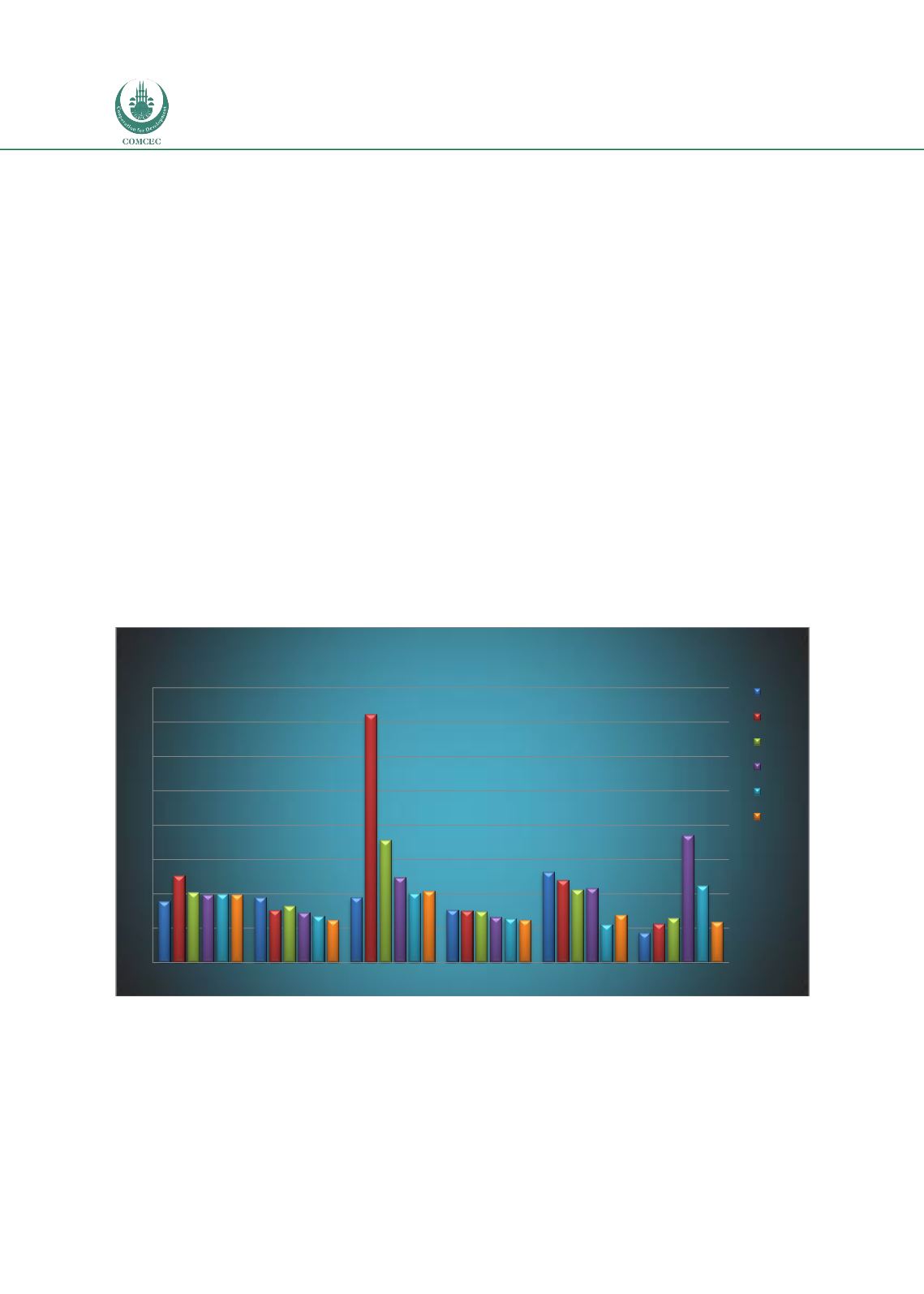
We compare capital adequacy ratios (CAR) for Islamic banks with those of the conventional
banking sector. In Malaysia, CAR ratios of Islamic banks are similar to conventional banks;
therefore, regulation of Islamic banking does not require any additional measures. In Saudi
Arabia, CARs of Islamic banks were relatively lower than the CARs of conventional banks in
2008; however, over the last few years, Islamic and conventional banks have exhibited similar
CAR ratios. The general observation of similar CAR ratios for the Islamic conventional banking
sector also holds true for the Turkish banking sector.
Figure 43: Islamic Banking Tier-1 Capital Ratio
Source: KFHR
0
10
20
30
40
50
60
70
80
UAE
MALAYSIA SAUDI ARABIA TURKEY
PAKISTAN INDONESIA
Islamic Banking Tier-1 Capital Ratio
2008
2009
2010
2011
2012
2013