



 83 / 176

Improving Banking Supervisory Mechanisms
In the OIC Member Countries
66
5. Regulatory and Supervisory Challenges of Islamic Banking after
Basel III
According to the World Islamic Banking Competitiveness Report by the EY in 2014, Islamic
banking asset size is expected to grow to 1.6 trillion USD. Considering that the total asset size
of Islamic banking in 2012 was around 600 billion USD, this will be a remarkable growth
episode. Estimates of the EY show that there are 38 million customers globally who use Islamic
banking products. Particularly, Qatar, Indonesia, Saudi Arabia, Malaysia, UAE and Turkey are
classified as the country group expected to exhibit most significant growth in Islamic banking.
We compare the total asset size of Islamic banking with that of conventional banking in the
selected OIC member states and observe a similar pattern. Saudi Arabia and the UAE,
especially, have the highest Islamic banking to conventional banking ratio in terms of their
asset sizes. Turkey and Indonesia are the next two countries on this list.
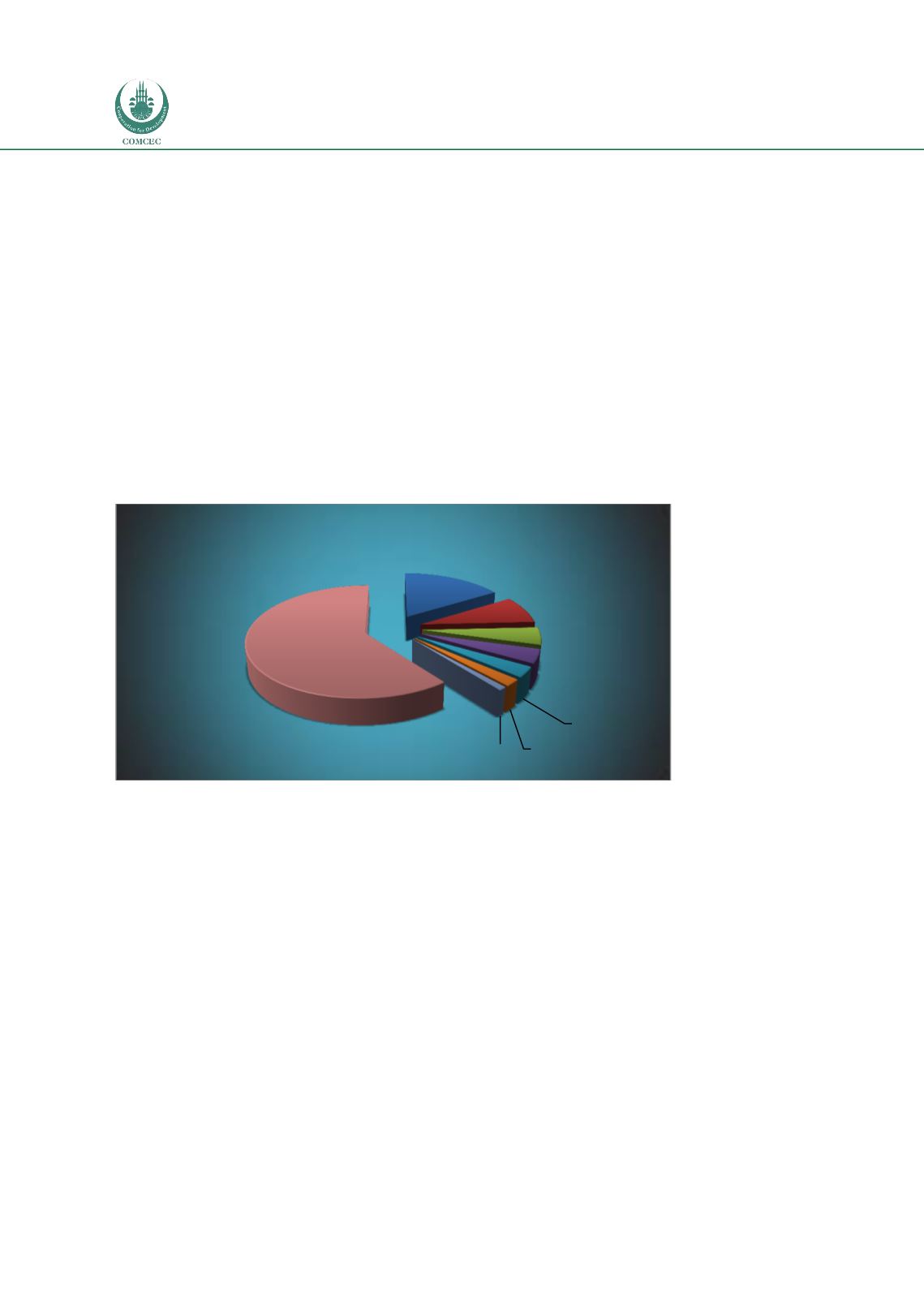
Distribution of Islamic banking assets is presented in Figure 40, which shows that many of the
selected OIC member countries possess significant amounts of Islamic assets.
Figure 40: Distribution of Islamic Banking Assets
Source: IFSB
Figure 41 provides a comparison of the growth rates of Islamic banking among the selected
OIC member countries; it shows a significant increase in Islamic banking in most of the
countries. Turkey, Indonesia and Qatar attain the fastest growth rates of Islamic banking
compared to other selected OIC member countries.
Saudi Arabia
16%
Malaysia
8%
UAE
5%
Kuwait
4%
Qatar
3%
Turkey
2%
Indonesia
1%
Rest of the World
61%
Distribution of Islamic Banking Assets (2013)