



 35 / 176

Improving Banking Supervisory Mechanisms
In the OIC Member Countries
18
banking sector tend to hinder the long term growth potential of an economy, therefore
a larger bank asset size with respect to the size of the economy is usually seen as a
positive indicator.
3.1.2.1 Banking Sector Growth and Economic Development
The relationship between financial development and economic development has been an
important issue in economics. Walter Bagehot (1873) and Sir John Hicks (1969) argue that
financial development played a critical role in stimulating industrialization in England by
facilitating the mobilization of capital. Joseph Schumpeter (1912) stated that well-functioning
banks stimulate technological innovations by identifying and funding the successful
production processes. Recent studies in the field of development and finance also support
these initial ideas. Levine (1997, 2005), suggest that a growing body of empirical analyses,
demonstrate a strong positive link between the functioning of the financial system and long-
run. While this framework is very supportive in theory, the recent crisis hit the developed
countries has questioned the validity of the above assertion. Especially highly levered and
fragile financial system can also be detrimental for the real economies. So, we will investigate
the performance of the selected OIC member states from this framework. Comparing its
banking sector asset size with respect it’s GDP, banking penetration with that of developed
countries. At the same time, we compare and contrast the selected OIC member states banking
potential risks with that of developed economies.
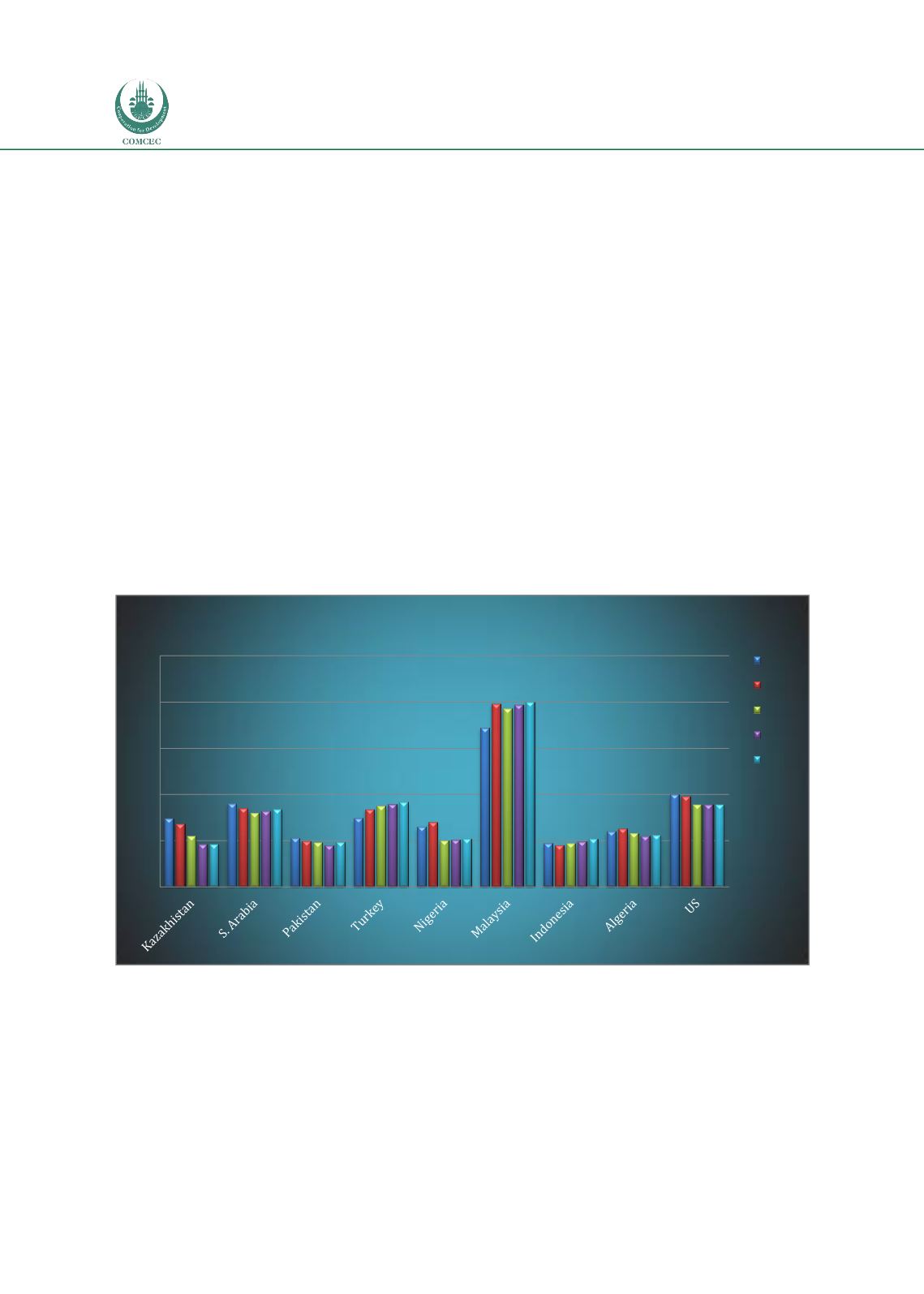
Figure 4: Bank Assets
Source: World Bank
The selected OIC member states’ bank asset sizes relative to their GDP is presented in Figure 4.
Generally, a country with a Total Asset/GDP ratio higher 100% can be considered to have a
relatively well-developed banking sector. Majority of the countries, with exception of Malaysia,
do have ratios smaller than 100%. Apart from Nigeria and Kazakhstan, mainly the asset/GDP
ratio is stable and exhibits an upward trend. In terms of the size of this ratio, Malaysia
constitutes a big exception. Malaysia's asset size is twice as big as its GDP. As discussed before,
under normal conditions, having a larger banking sector could be beneficial for the economic
growth. However, even the bank asset size in Malaysia is relatively small considering European
0
50
100
150
200
250
Bank Asset (% of GDP)
2008
2009
2010
2011
2012