


 26 / 162

Single Window Systems
In the OIC Member States
16
A successful Single Window project is expected to lead to
Improved compliance management;
Improved process efficiency with better resource allocation;
Reduced process times through less idle times and agency collaboration; and
Reduced indirect and direct costs of formalities.
1.3.2
Impact of Digitisation and Process Re-engineering
Single Windows deliver these benefits through the digitisation and re-engineering of
processes. The digitisation of front-end procedures and back office processing substantially
change the operating environment for traders and government authorities alike.
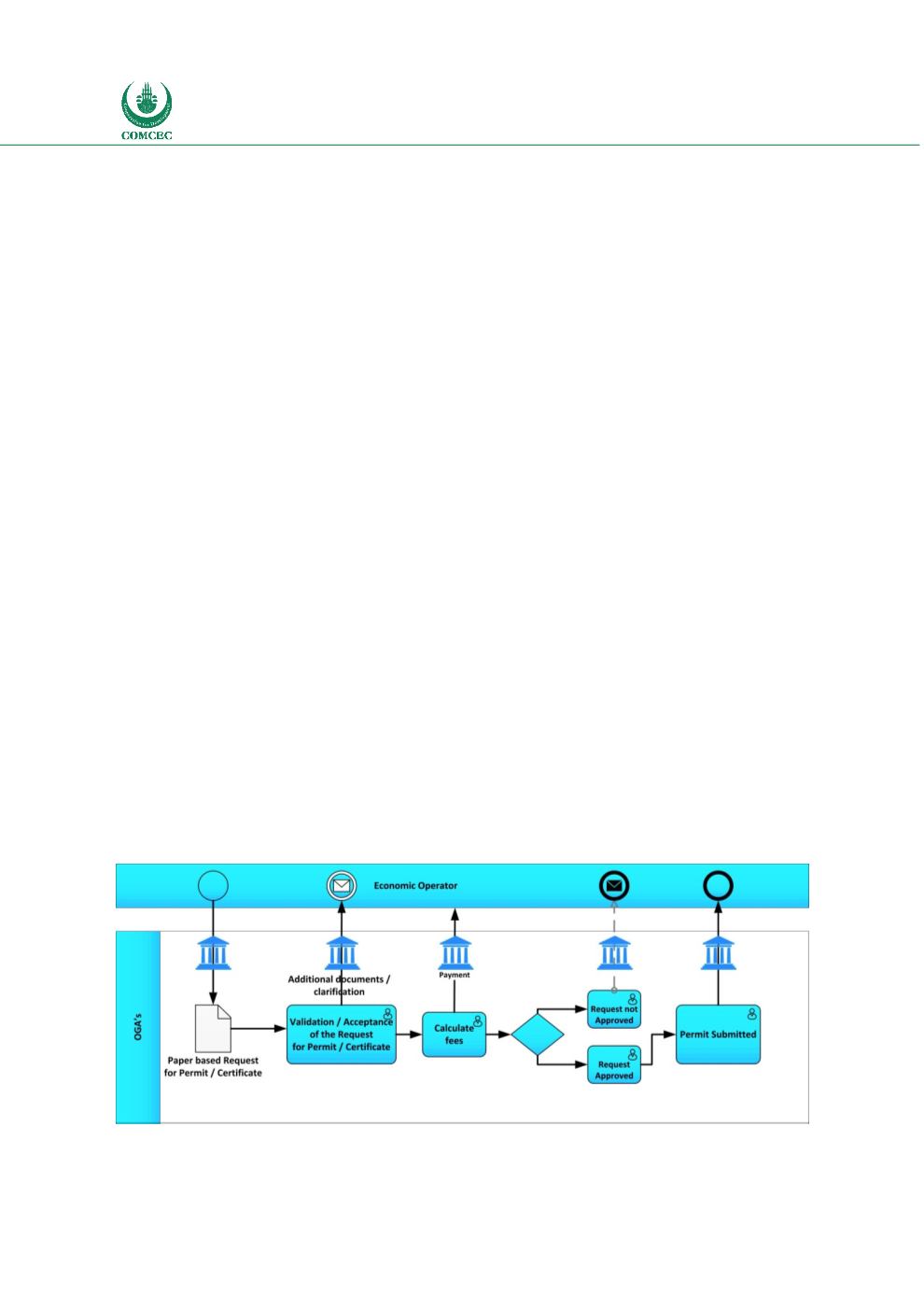
Figure 6and
Figure 7present a business process, i.e. the application for a permit from a
government agency, through a Single Window first as an analogue and then as a digital
process, to illustrate the change impact.
In the analogue process, economic operators have at least three physical contacts points with a
government agency. The agency processes the request manually in a succession of at least five
separate activities. This process is repeated each time an agency has to be contacted.
In the digital process, economic operators have two digital contact points with the SW, and do
not contact the government agency directly. The request is processed digitally, with analogue
decision making by the relevant government agency. In the digital environment, multiple
OGA’s can be integrated into the Single Window without increasing the number of contact
points, i.e. the Single Window portal, or without an increase in the number of process if the
Single Window implements the Single Form or Single Submission approach – see Chapter 2.1.
Current Trends.
Furthermore, the analogue decision-making can be replaced by automated decision making if
the necessary rules are integrated into the Single Window.
Figure 6: Analogue Permit Application Process
Source: Authors’ own construction