


 100 / 231

Diversification of Islamic Financial Instruments
86
According to the IMF, the reforms have had a widely positive impact on the Sudanese financial
system. The main monetary aggregates and the deposits stared rising in real terms, and real
rates of return became positive which stimulated growth in private deposits with commercial
banks. Nevertheless, regardless of the progress achieved, the overall level of financial
intermediation remains low, and the banking system is still weak and largely undercapitalized
(IMF, 2001). This is consistent with recent indicators where Sudan got the 11
th
place in the
Islamic Financial Development Indicator (IFDI)
67
, despite the relatively long experience of
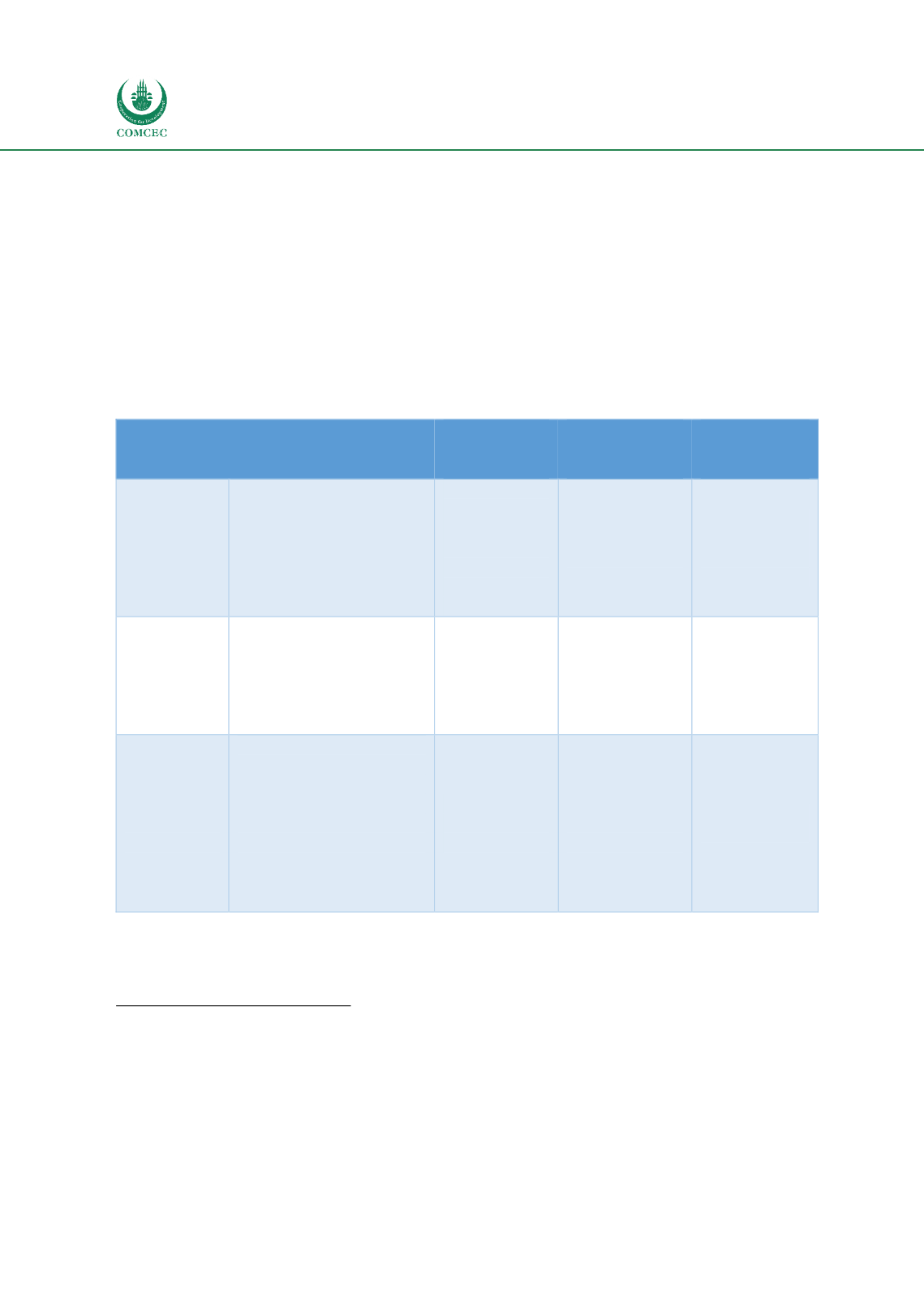
Sudan in Islamic banking and finance. The Table below shows the main regulatory authorities
in the financial sector in Sudan and the IFIs and sectors they cover, while the next Table
(Financial inclusion indicators) exhibits the position of Sudan in the IFDI comparing to other
countries.
Table 36: Main Authorities of Financial Sector in Sudan
Central Bank of Sudan
Khartoum
Financial
Market
Insurance
Supervisory
Authority
National
Agency for
exports credit
Legal
framework
The Act of 2002 and its latest
amendment in 2012
Act of
organizing
Capital markets
of 2016
Act of Khartoum
Financial Market
of 2016
Act of supervision
on Insurance
companies of
2001
Act of the
National Agency
for export credit
of 2004
Main roles
Regulatory and supervisory
Regulatory and
supervisory
Regulatory and
supervisory and
developing the
insurance sector
in line with
Shariah
Developing
exports sector
through Islamic
financial and
insurance
instruments
Institutions
and
companies
under
coverage
Commercial, specialized and
investment banks - SME's
financing institutions -
Electronic services company -
Forex exchange companies -
Sudan financial services
company - Banks deposits
guarantee funds - Liquidity
management fund
Financial
brokers and
intermediaries
Takaful and
retakaful
companies
Sudanese
exporters
Source: Official Sudanese websites
Despite the relatively long history of banking system Islamization, the above table shows that
Sudan is still behind many Arab and Muslim countries in terms of the development and the
67
The ICD Thomson Reuters Islamic Finance Development Indicator (IFDI) represents the overall health and development of
the Islamic finance industry worldwide, using one composite and weighted numerical measure. For 2016, IFDI tracks the
performance of 124 nations assessed against 5 indicators: Quantitative Development (QD), Knowledge, Governance,
Corporate Social Responsibility (CSR) and Awareness. These indicators are broken down into a total of 15 sub-indicators,
which take into account 55 different metrics-related and 3 rationalizing coefficients (total banking assets, GDP and
population) that adjust indicator values to each country’s size. Hence, more than 6,300 country-level metrics and data are
entered to calculate IFDI average global indicator values. The methodology chapter of this report explains the IFDI
methodology in full.