



 51 / 176

Improving Banking Supervisory Mechanisms
In the OIC Member Countries
34
3.1.5 Liquidity Risk and Basel III in Selected OIC Countries
In terms of the ability of liquid funds to cover short-term needs of banks, we focus on the ratio
of liquid assets to the short-term liabilities. For this measure, Turkey and Pakistan reach a
level above 80%, which is in line with the ratio in US. For other member states used in the
analysis, we observe ratios ranging between 25%-60%.
Liquidity conditions in the financial markets are crucial for a well-functioning banking system
because during the times of financial stress, we observe quick and severe evaporation of
liquidity putting banks into difficulties. In this regard, BASEL III imposes new constraints on
the amount of liquid assets banks need to hold to match both short and long-term cash
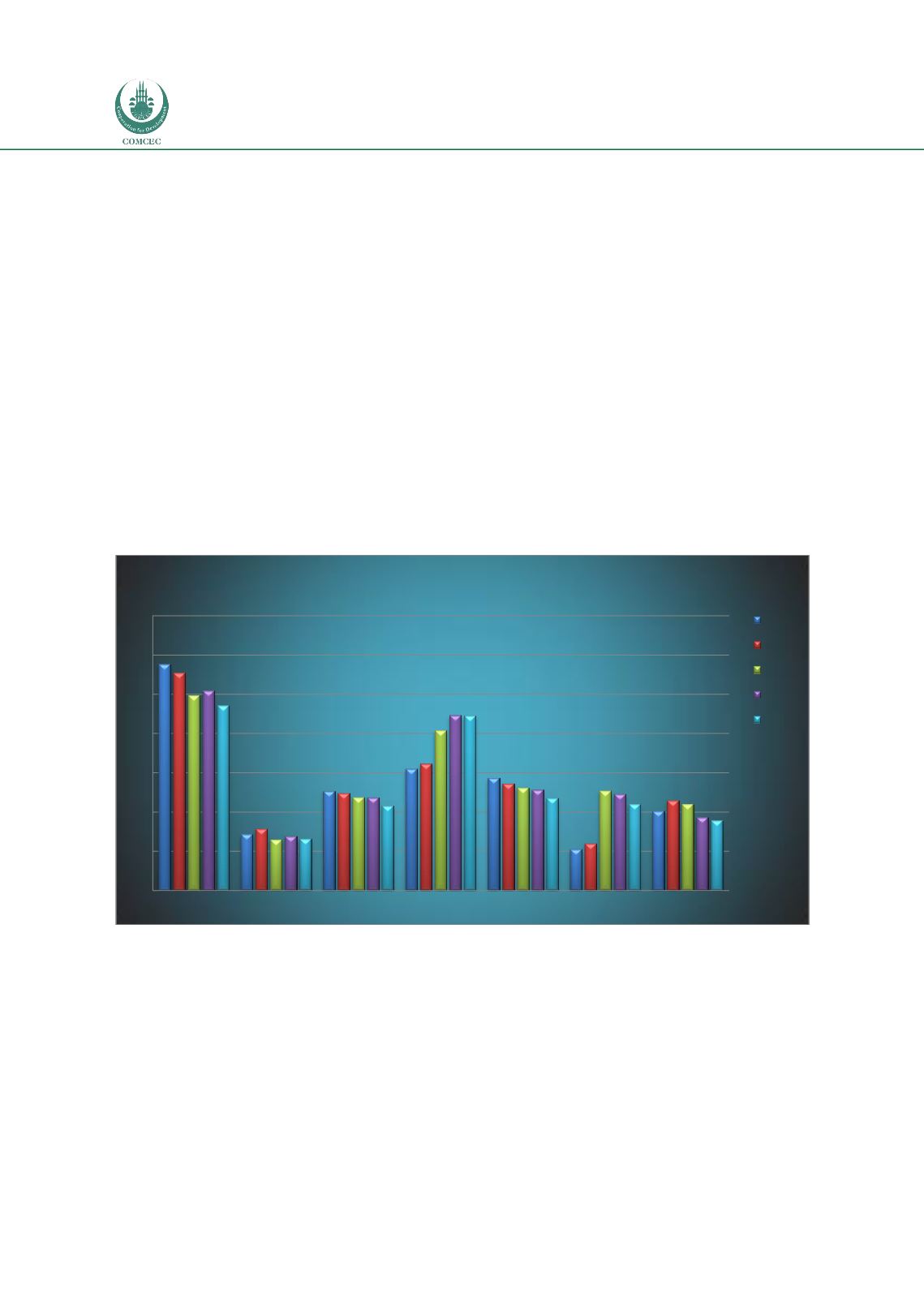
outflows. Figure 29 and Figure 30 present the ratio of liquid assets to total assets and to short-
term liabilities of the banking system in the member states for which data are available, in a
comparison to the Euro area and US for the period 2008-2014. These measures do not directly
comply with LCR or NSFR however; they still provide a clear picture of liquidity conditions
from a comparative perspective. The fraction of liquid assets to total assets vary between 15-
30% for Malaysia, Kazakhstan, Nigeria, Indonesia and Saudi Arabia which are mostly above the
corresponding ratio in US. Turkey and Pakistan are positively separated in this measure with a
ratio above 40%.
Figure 29: Liquid Assets over Total Assets
Source: IMF-FSI
0
10
20
30
40
50
60
70
Turkey
Malaysia Saudi Arabia Pakistan Indonesia
Nigeria Kazakhistan
Liquid Assets to Total Assets
2009
2010
2011
2012
2013