


 107 / 247

86
Another important element that has shaped the supply side is credit rating, which provides
guidance on an issuer’s creditworthiness and facilitates price benchmarking. Credit ratings
offer numerous benefits, predominantly investor-driven due to the requirement for
continuous monitoring and surveillance of their investment portfolios. Since the release of the
initial PDS guidelines by BNM in 1989, credit rating had been mandatory in Malaysia until end-
2016. Effective 2017, the mandatory credit rating requirement has been withdrawn to allow
market forces to determine the added advantage of independent credit opinions, a practice
adopted by developed countries.
Investors and issuers need to consider a multitude of risks, including inflation, interest rates,
liquidity, credit, industry and market performance when evaluating their bond-/sukuk-related
decisions. Supporters of rated bonds/sukuk argue that credit ratings improve market
transparency through independent and comparable assessments of creditworthiness.
Ultimately, investors will need to weigh the pros and cons in light of their responsibilities to
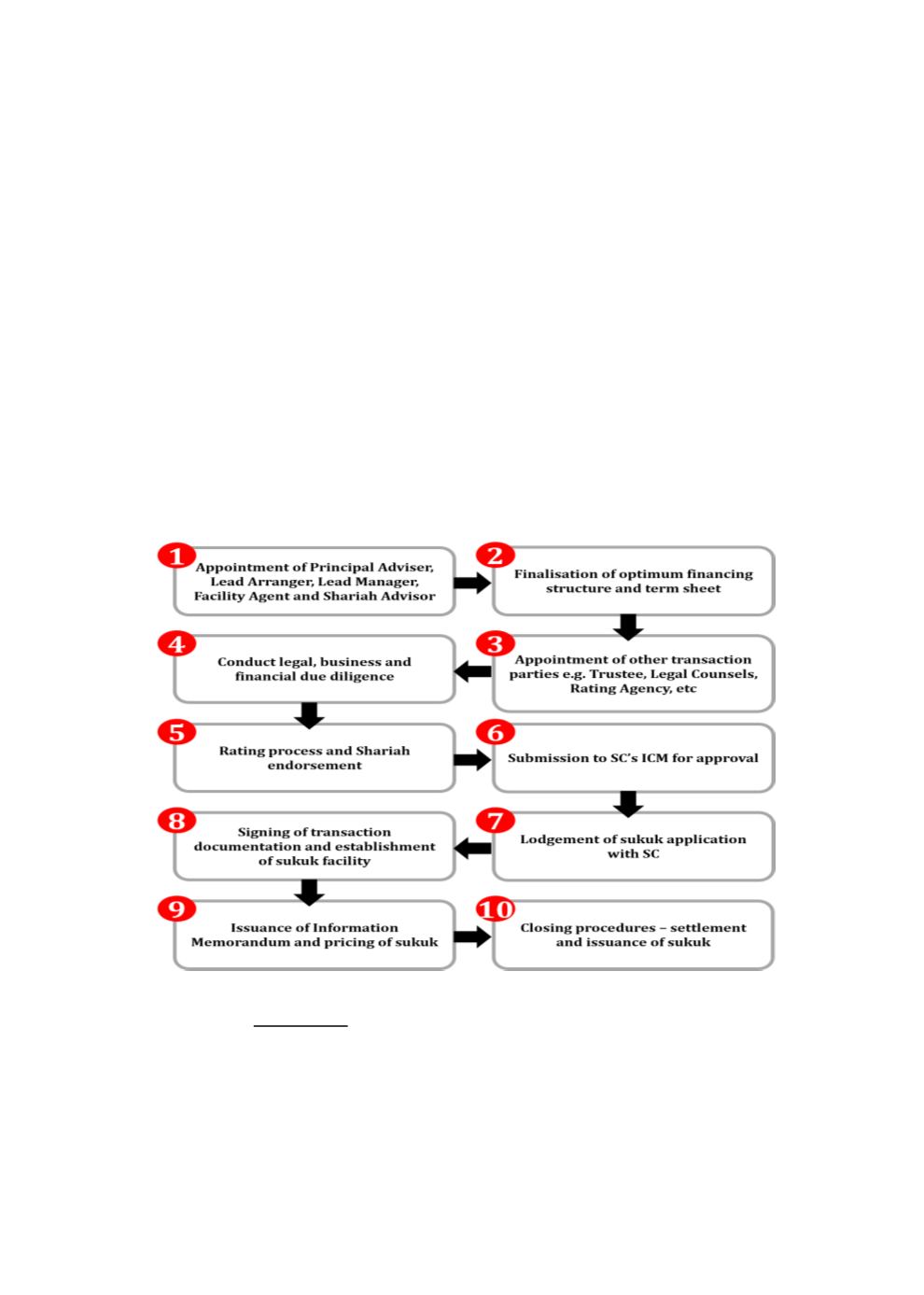
monitor and assess risks on an ongoing basis. Figure 4.4, illustrates the process flow for sukuk
issuance in Malaysia, of which credit rating or the credit process is a critical component.
Figure 4.4: Process Flow for Sukuk Issuance in Malaysia
Source: RAM
Analysis of Sukuk Investments – Demand (Buy Side)
Malaysia has one of the largest and most liquid capital markets, characterised by a deep
institutional investor base. The intermediation provided by its capital markets has allowed the
matching of long-term, capital-intensive spending with the long-term liquidity provided by
institutions, pension funds and insurance companies, among others.