


 48 / 247

The Role of Sukuk in Islamic Capital Markets
30
the interests of the sukuk holders. Therefore, the trustee must always exercise reasonable
diligence to ascertain whether the issuer has committed any breach of the terms and
conditions of the sukuk, or the provisions of the trust deed, or whether an event of default has
occurred. In such an event, proper notice should be given to the beneficiaries. The trustee may
extensively cover the role of an intermediary or caretaker that manages the entire transaction
of the sukuk until maturity, or may serve as an arbitrator when necessary (Hasan et. al, 2012).
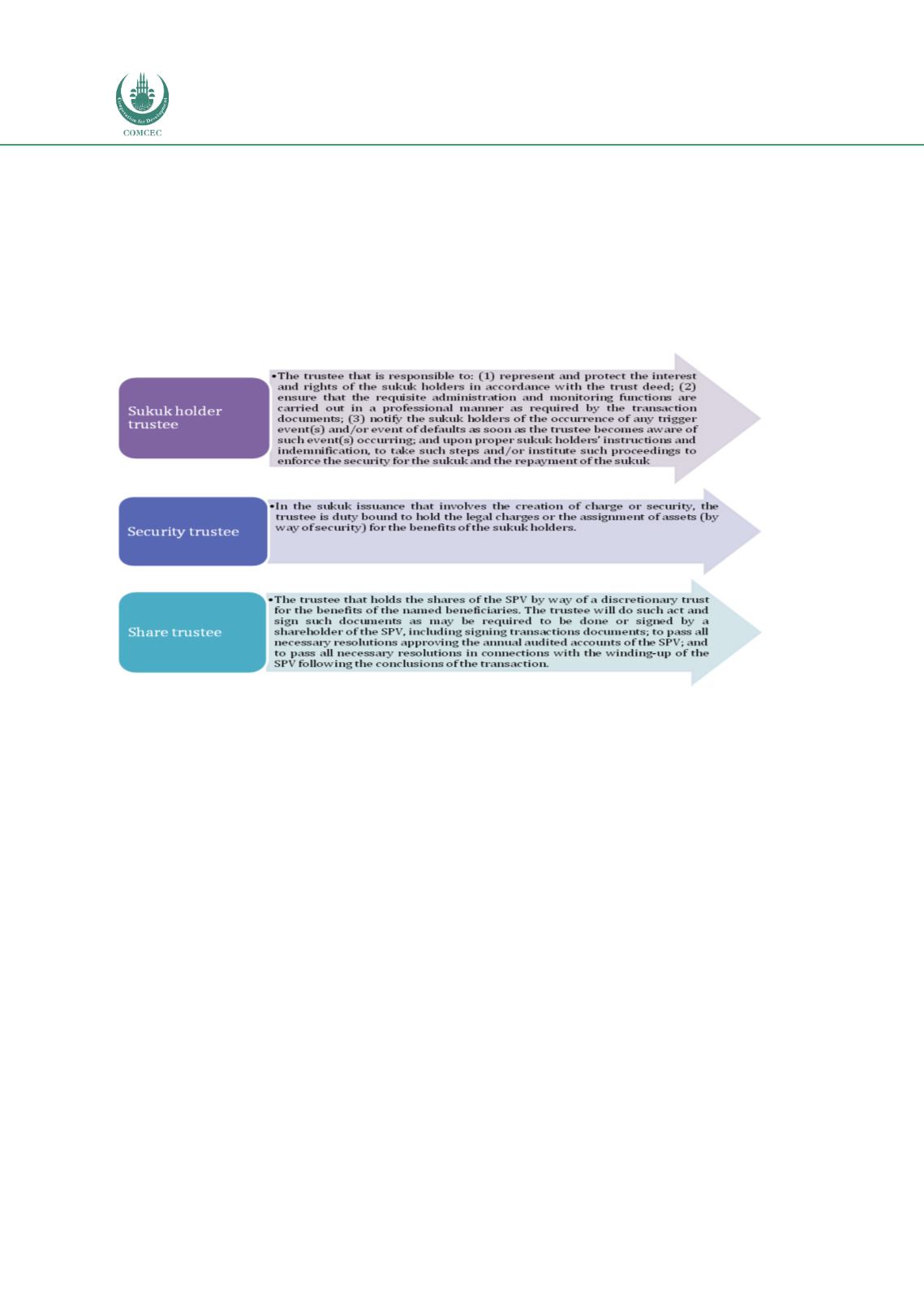
The trustee can be categorized into 3 types, depending on its function, as described in Figure
2.10.
Figure 2.10: Types of Trustee
Source: Hasan et al. (2012)
2.6.2
REGULATORY
In general, there are 3 broad approaches to a regulation adopted by different legal systems to
various degrees. These are: (i) the fraud and abuse inhibition approach, which inhibits fraud
and related abuses in the market; (ii) the merit approach, where the regulator intervenes to
warn investors about the relative merits of an investment; and (iii) the fair dealing approach,
which reflects fair dealing in market transactions (ISRA, 2015). Most jurisdictions seek to
regulate ICM transactions premised on these principles-based approaches. These are in line
with IOSCO’s core principles for securities regulation, i.e. the protection of investors; ensuring
markets are fair, efficient and transparent; and the reduction of systemic risk - all of which are
also applicable to the regulation of Islamic securities. The IOSCO’s (2004)
Islamic Capital
Market Fact Finding Report
does not specify separate regulation for the development of an
ICM, as delineated in Box 2.2. It does, however, recommend the establishment of an
appropriate Shariah governance framework that would regulate the Islamic capital market.