


 35 / 247

The Role of Sukuk in Islamic Capital Markets
17
2.2.3
PIONEERING COUNTRIES IN THE SUKUK MARKET
Shell MDS Malaysia Sdn Bhd’s sukuk issuance in 1990 is widely recognized as the market’s
pioneer sukuk. It was the first ringgit-denominated corporate sukuk and was issued by a non-
Islamic company in a Muslim-majority country, i.e. Malaysia. Over the years, Malaysia has
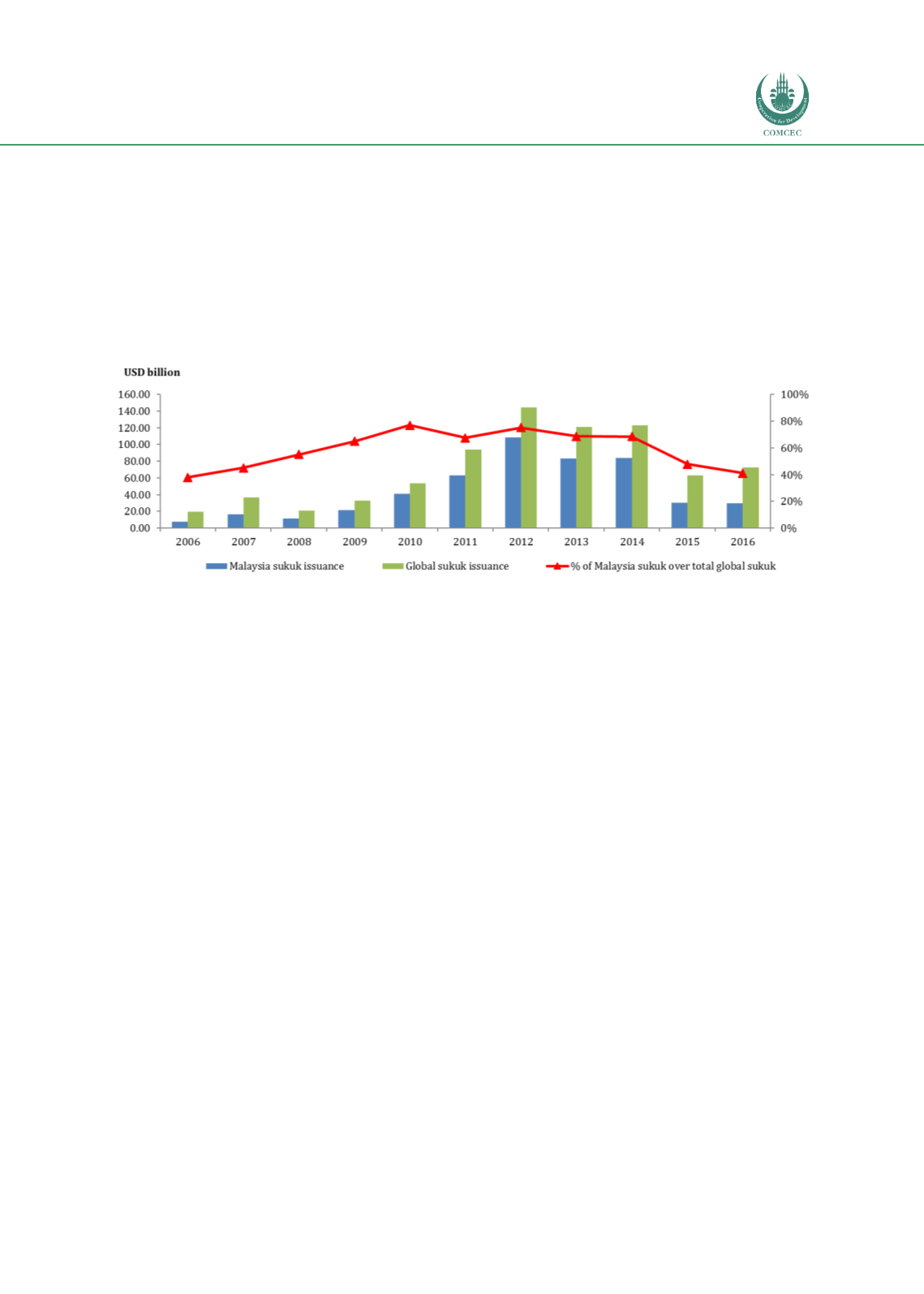
evolved into a leading centre for sukuk issuance accounting for a significant share global
issuance, as reflected in Chart 2.3.
Chart 2.3: Malaysia vs Global Sukuk Issuance
Sources: Eikon-Thomson Reuters, RAM
Sudan was another pioneer of sukuk issuances in the 1990s. The Sudanese government
developed sukuk as an alternative monetary policy instrument for open-market operations,
such as:
Shahama
Bonds or Government
Musharakah
Certificates (GMCs). These are short-term
securities issued since 1999, to raise short-term government financing to cover such
costs as civil service and defense expenses (Institute of Islamic Banking and Insurance,
2009).
Government Investment Certificates (GICs). These are medium-term securities,
whereby the Ministry of Finance is the originator and the money raised is invested in
specific projects financed by the government.
Central Bank
Ijara
Certificates (CICs), which are backed by the buildings owned by the
Central Bank of Sudan.
In recent years, some countries outside the key markets have launched some pioneering
issues. These debut sukuk reflect the positive market momentum at present. Some of these
ground-breaking issuances by the new entrants in the sukuk market are shown in Figure 2.2.