


 39 / 231

Diversification of Islamic Financial Insturments
25
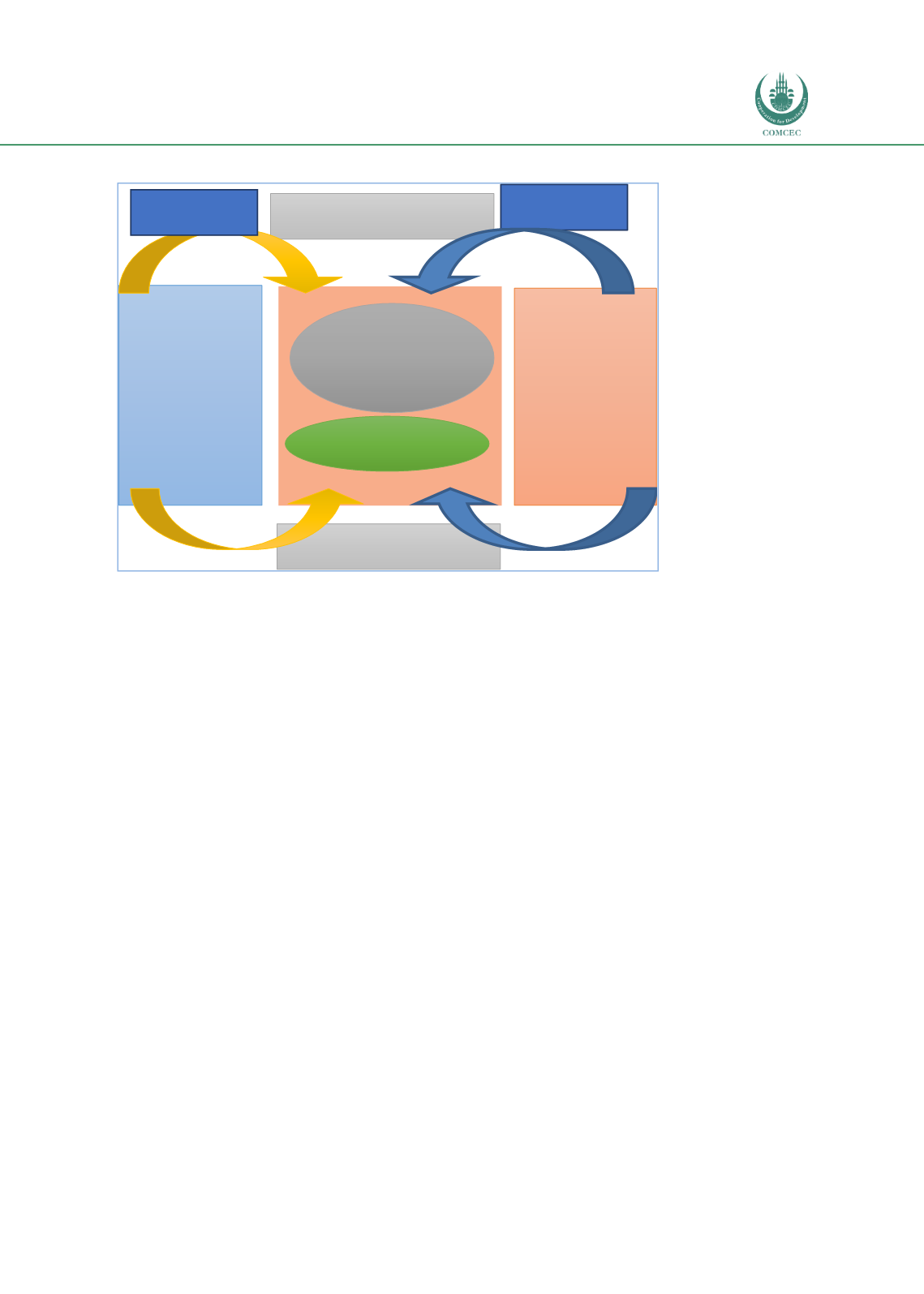
Figure 3. Overall Economy
Source: Created by Author
The Islamic Capital Market (ICM), which broadly refers to the market in Islamic securities, is
one of the fastest growing segments of the capital market. In the case of Malaysia and Bahrain,
it permeates all segments of the capital market, equities, bonds, foreign, exchange and
derivatives. Islamic securities are simply capital market instruments that are Shariah
compliant. While such compliance has been fairly easy where equity instruments are
concerned, the bond market has had to completely redesign the instruments in order to be
Shariah compliant. Since equity financing is in congruence with the Shariah, listed equities and
derivatives merely had to be screened in order to determine their acceptability as a ‘halal’
stock.
The Islamic capital markets can be divided into three sub components which are prevalent in
most Islamic financial instruments namely the Sukuk Market, Equity Markets and Islamic
Funds Markets. The last few years have witnessed some volatility in these markets and
setbacks recently, including contractions in returns and asset values. This is not unique to
Islamic capital markets as the global trend has been of volatility and reducing returns in
conventional emerging markets as well. Most OIC member countries and Islamic finance
destinations fall under the category of emerging and developed economies which have
suffered in the recent years owing to moderation in the global economic growth with risks
shifting to the emerging markets and its associated macroeconomic rebalancing pressures.
Along with these factors political and geopolitical conflicts have impacted the Islamic capital
market growth as well. These facts don’t lead to serious shrinking of the sector, as Islamic
capital markets are still garnering interest and new entrants. Since 2015, Sultanate of Oman,
Cote D’Ivoire in the sovereign sector, and World Bank in multilateral agency category have
tapped into the Islamic Capital markets by issuing Sukuk. Like this the number of Islamic funds
has been on steady increase by increasing above 1000 publicly available Islamic funds across
different asset classes of investments by the end of 2015.
Real Sector
Indirect Financing
Surplus Units:
Households
Corporate
Government
Foreign
Investor
Deficits Units:
Households
Corporate
Government
Foreign
Investor
Banking System &
Other Financial
Intermediaries
Capital Markets
Direct Financing
Real Sector