


 108 / 231

Diversification of Islamic Financial Instruments
94
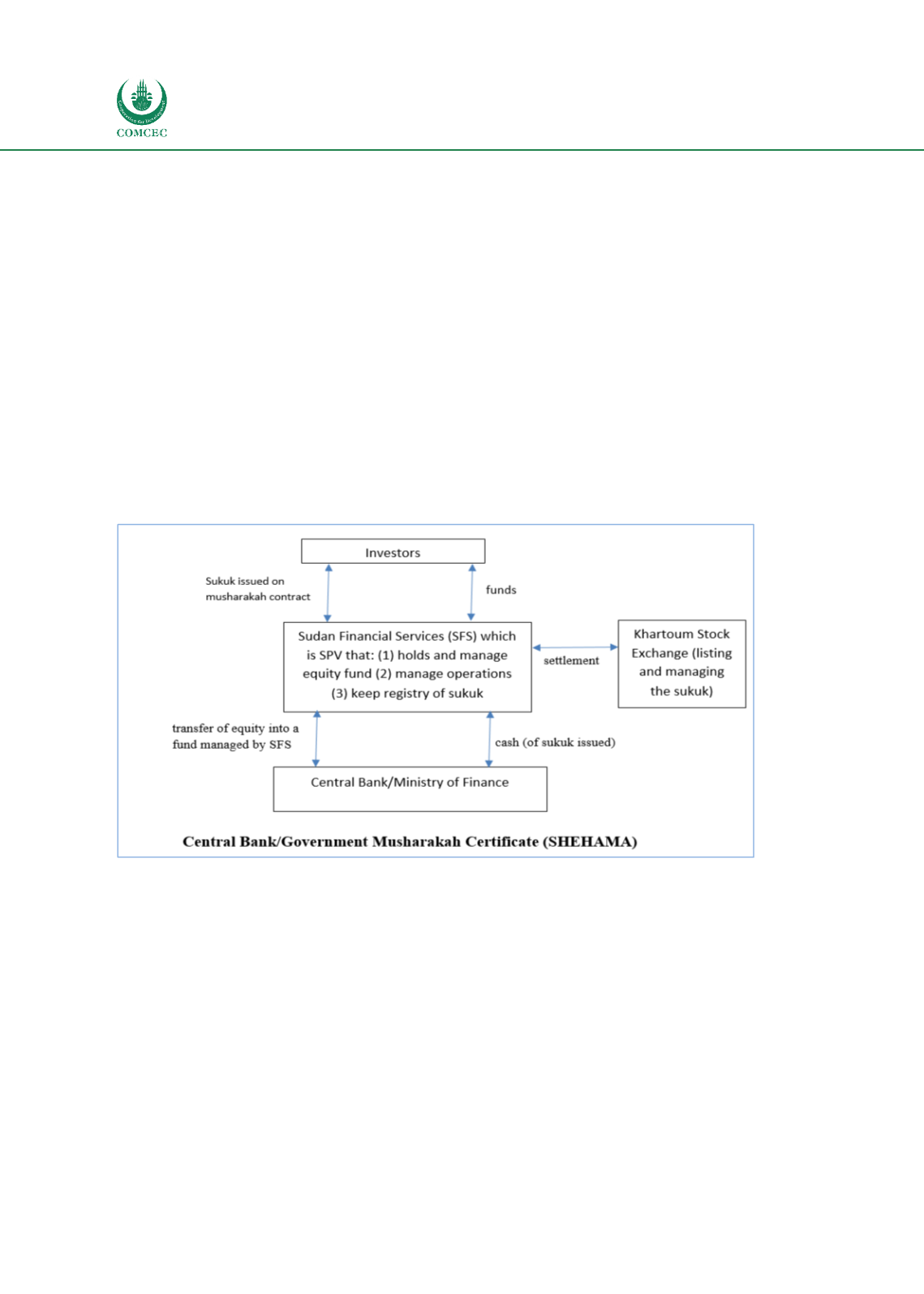
Government Musharakah Certificate (GMCs) – SHEHAMA
“From 2001 to early 2007 the government used short-term GMCs (SHEHAMA) to finance the
government budget deficit. Investment in GMCs was restricted to Sudanese only. Investors
received ownership interest in a portfolio of specific state-owned enterprises, whose profits
were distributed as pro-rated bullet payments at maturity. GMCs were tradable in the
secondary market immediately after issuance. In early 2007 the government discontinued
GMCs following reduced short-term financing needs. GMC is designed as an instrument based
on a profit- and loss-sharing contract. It is an asset based security issued against a certain
percentage of Government ownership in more profitable and joint venture enterprises. The
returns form GMC are determined by the expected return on the underlying asset where a pro-
rata share of the income stream is distributed between the partners. Among its features GMC is
fixed short-term maturity (one year), listed on and traded in the stock exchange (transferable
and fully negotiable), accessible to all, provides financing for Government’s budget deficit
through a non-inflationary instrument and can be used as a tool for open market operations”
(Sarker 2015).
Figure 12. Government Musharakah Certificate- SHEHAMA
Source: IIFM (2016)
Government Investment Certificate (GICs) – SARH
“In 2003, the government also introduced GICs to fund its trade, procurement, and
development projects. Unlike GMCs, investors are shareholders of an investment company
managed by SFSC and do not hold a title to government assets. GICs can also be traded in the
secondary market. GIC is designed as an asset-based security issued against a number of
contracts, including
Ijarah
,
Salam
,
and Mudarabah
. The relationship between the holder of a
GIC and the issuer is based on a restricted Mudarabah contract. The instrument’s maturity
profile ranges from two to six years. The expected return is determined by the fixed rental
income on
Ij
a
rah
plus the income from the sale of
Murabahah
,
Salam
and
Istisn
a
contracts.
Profit is distributed every three or six months. Sales of primary issues are made through an
auction system. The GIC is listed on the stock exchange. Among its features GIC appears