




 71 / 127

Barriers and Opportunities for Enhancing Capital Flows
In the COMCEC Member Countries
63
scores across all time periods for the pool of COMCEC Countries. Three BER categories –
foreign trade and exchange regime (shown here), market opportunities, and financing –
revealed the trend that higher BER scores related to higher levels of private capital flows.
Does economic size matter?
To explore whether the size of the economy is a factor in attracting capital flows, we
examined private capital flows in relation to GDP. As can be seen with the foreign trade and
exchange regime categories (shown here), there is a positive relationship when private
capital flows are viewed as a share of GDP.
Does an improving business environment induce growth in private capital flows?
The next step was to seek evidence that a changing business environment attracts capital
flows. In the data analysis we tracked the change in a BER category and the change in capital
flows. The financing category (see right), shows a moderately positive relationship, implying
that an improving financial environment induces capital flows. The picture was less clear,
however, for the other BER categories.
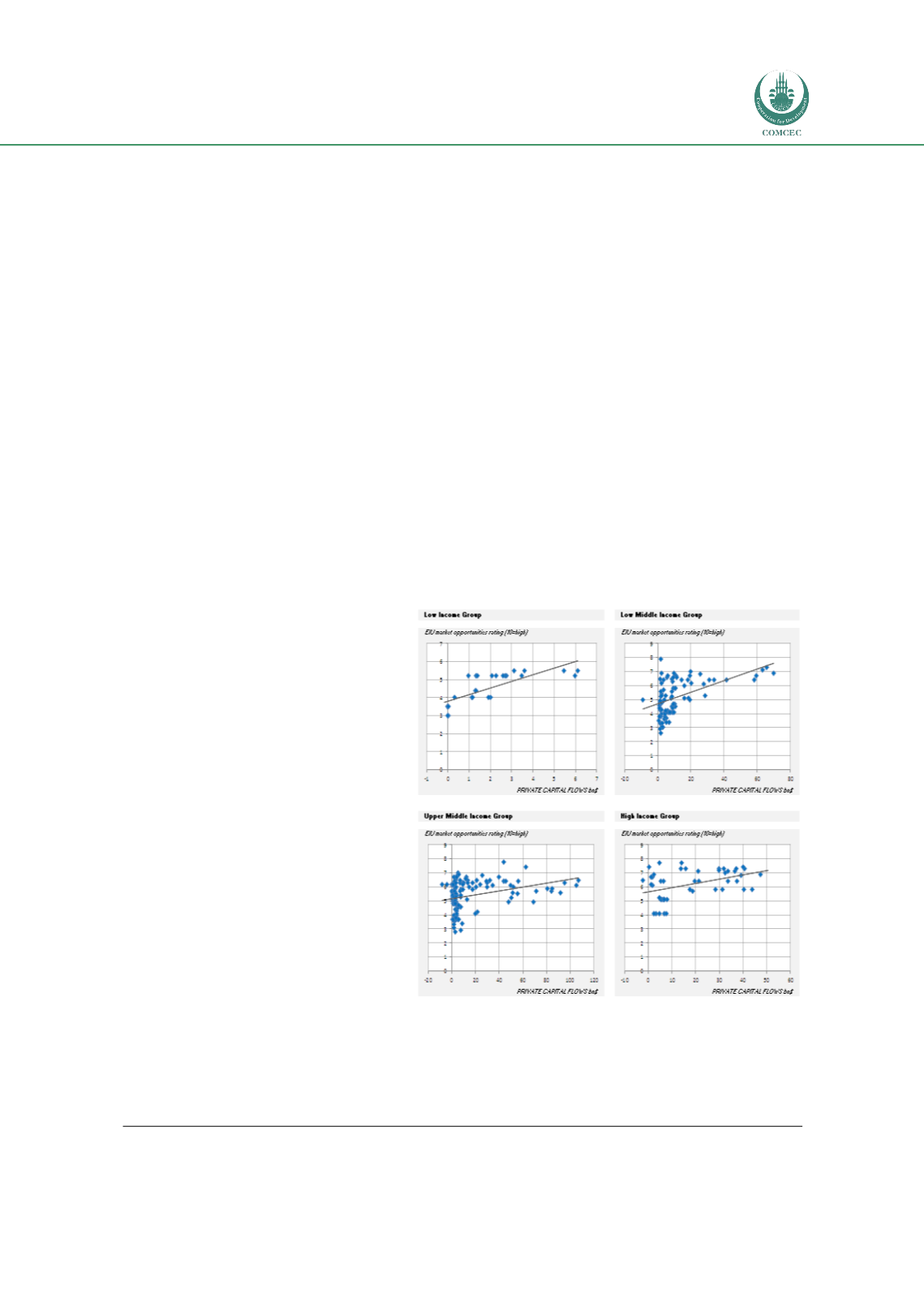
Does the apparent effect of the business environment depend on the level of income?
The EIU conducted further analysis
on the basis of the World Bank’s four
income categories – low-income,
lower-middle income, upper-middle
income, and high income. This
enabled analysis of the influence of
the business environment for high
and low income countries. The three
BER categories – foreign trade and
exchange
regime,
market
opportunities, and financing – were
more relevant for lower income
countries.
The
macroeconomic
environment and policy towards
foreign investment showed no such
pattern across income groups.
Caveats
The data analysis discussed here is
preliminary in nature and does not allow firm conclusions to be drawn about the causality
of the BER scores examined here. While this analysis can point towards potential
relationships, a more sophisticated regression analysis would need to be undertaken to be
able to make more conclusive statements about the causal link between BER scores and
private capital flows.