



 70 / 127

Barriers and Opportunities for Enhancing Capital Flows
In the COMCEC Member Countries
62
rates, in developed economies, which encourage borrowers in developing markets to borrow
in international currencies rather than in their own domestic currency.
64
However, recent data indicates a reversal in portfolio equity flows and reduced bond inflows
on a global level since March 2013,
65
as investors have started to price in a tighter monetary
stance on the part of the US Federal Reserve. In time, it is likely that the boost to emerging
market capital inflows from global monetary policy will fade, as the interest rate differential
between emerging markets and mature economies continues to narrow. As such, solid
fundamentals are an increasingly urgent priority for recipient countries. Countries expecting
to attract private capital inflows will increasingly need to count on solid fundamentals at home
rather than favourable liquidity conditions globally.
What is the relationship, if any, between the Business Environment Rankings of the
EIU and private capital flows?
The EIU conducted a preliminary data analysis of its
Business Environment Rankings (BER)
66
scores to
ascertain what insights, if any, could be drawn on the
determinants of private capital flows. The EIU selected
five BER categories for this analysis, based on their
possible relevance to private capital flows:
-
Macroeconomic environment – this category
includes factors such as average inflation, average
budget balance, external stability and exchange rate
volatility.
-
Market opportunities – includes GDP growth, GDP
per head, share of world merchandise trade and
profitability.
-
Policy and attitudes towards foreign investment –
consisting of government policy towards foreign
capital, availability of investment protection
schemes and risk of expropriation of foreign assets.
-
Foreign trade and exchange regimes – including
capital account liberalisation, tariff and non-tariff
protection and transactions on the current account.
-
Financing – covering the health of the banking
sector, stock market capitalisation and quality of
financial regulation.
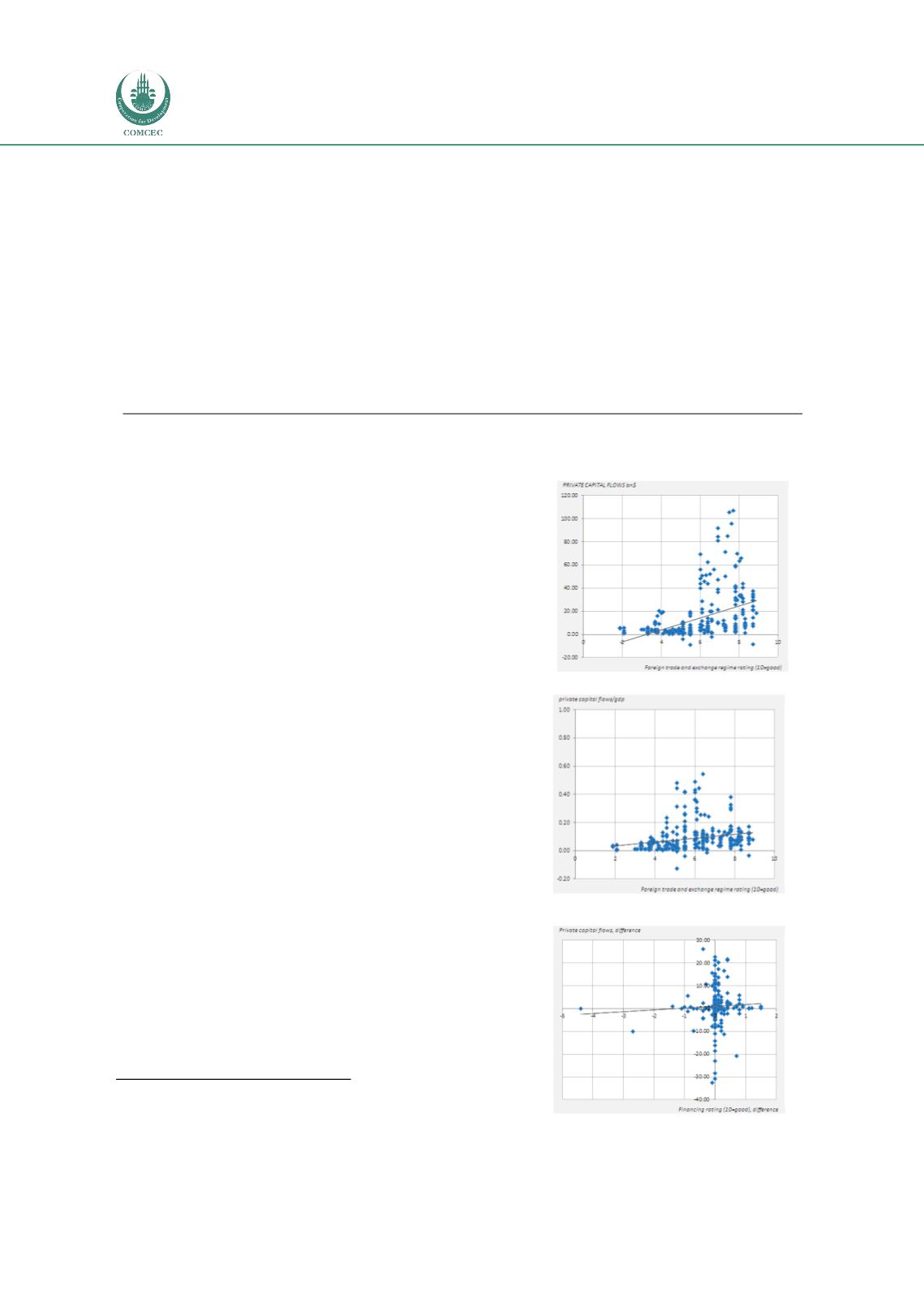
As a first step in this analysis of BER scores, we looked
at the relationships between capital flows and BER
64
“Capital Flows and emerging market economies”, Bank for International Settlements (BIS), Committee on the Global Financial
System, 2009.
65
, “Capital Flows to Emerging Market Economies”, Institute for International Finance (IIF) research note, June 26 2013
66
See Appendices for the BER methodology