




 69 / 127

Barriers and Opportunities for Enhancing Capital Flows
In the COMCEC Member Countries
61
Solid guarantees of financial institutions and implicit government support
Non-excessive regulation
Regulators with a sound understanding of exchange rate risk, credit risk, liquidity risk
and other risks.
4.4.
GLOBAL LIQUIDITY AS A DRIVER OF FINANCIAL FLOWS
Besides internal factors driving capital inflows to developing economies, external factors may
also play a role. Economists who hold the “external factor view” argue that capital inflows to
developing economies rise when financing conditions in investor countries ease. In these
cases, it is portfolio investment flows in particular that are strengthened by favourable
liquidity conditions and a benign macroeconomic environment across the globe; by contrast,
FDI inflows are more dependent on internal factors in the recipient country.
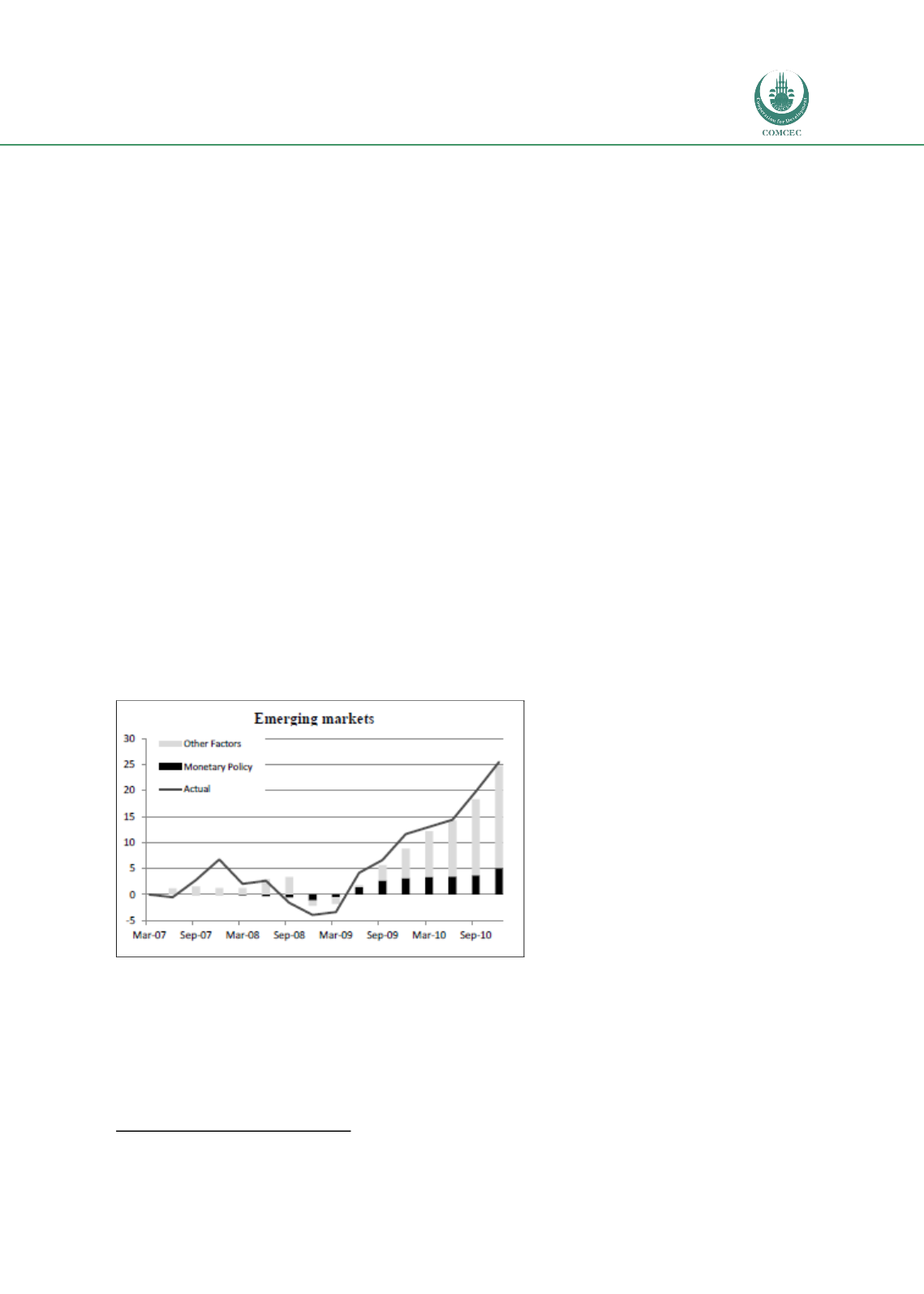
The role that external factors play in driving capital flows is highlighted by Figure 4.1 below,
from analysis undertaken by the European Central Bank showing that quantitative easing (QE)
policies of the US in recent years boosted portfolio capital inflows to many emerging countries.
Figure 4.1: The cumulative impact of US quantitative easing and other control variables
on equity portfolio flows
63
to emerging countries
Source: “On the international spillovers of US quantitative easing”, European Central Bank
Working Paper, June 2013
A number of drivers may explain this phenomenon, such as low interest rates in developed
economies, which encourage investors to search elsewhere for higher yields, or low interest
63
Expressed as a percentage of assets under management in the country of destination