


 83 / 231

Diversification of Islamic Financial Insturments
69
(Meezan, Dubai Islamic Bank Pakistan, Bank Islami and Bank AlBaraka), (b) one subsidiary
(MCB Islamic bank, established in 2015) and (c) seventeen Islamic banking windows. The
market share of Islamic Banking assets stood at 11.7% in December 2016, with the market
shares in terms of deposits at 13.3%
49
.
Pakistan has an active Islamic Banking department at the State Bank of Pakistan (SBP), the
Securities and Exchange Commission of Pakistan (SECP) and a Shariah Advisory Board at the
SBP serving as the highest authority for IFIs in the country. There is a legal framework in place
that is a combination of the Bahraini and Malaysian model, for any FI operating as (a) an
Islamic commercial bank, (b) an Islamic subsidiary of a conventional bank or (c) financially
separate Islamic branches of a conventional bank (Islamic windows). Of the 17 conventional
banks operating Islamic windows, two (Faysal Bank and Summit Bank) have announced their
intent to convert to full-fledged Islamic banks. Other conventional banks with Islamic branches
include Habib Bank, Bank of Khyber, Bank Al Habib, National Bank of Pakistan, United Bank
Limited, Askari Bank, Standard Chartered, BOP, Sindh Bank, Habib Metro etc. There are also
five Takaful companies operating in Pakistan (2015), though with no local IFI offering re-
Takaful products as yet. Though the Bahrain-based international AAOIFI standards for
Accounting, Auditing and Shariah are widely accepted by SBP and IFIs in Pakistan, their
implementation is still in its initial stages.
In terms of size, there are about 2075 Islamic banking branches operating in Pakistan
50
, with
Islamic banking assets totaling to PKR 1,853 billion by December 2016 (approx.. 17.7 billion
USD) with a 11.7% market share of the industry. Total deposits of Islamic banks stood at PKR
1,573 billion (13.3% of the industry). The share of Islamic Banking assets in Pakistan, which
was 12.8% (Dec 2015) of the total banking industry rose to 13.3% December 2016, and the
figure is targeted to reach 20% by 2020. In fact, between 2010 and 2015, the Islamic banking
industry experienced a compound annual growth of over 30% both in terms of assets and
deposits.
51
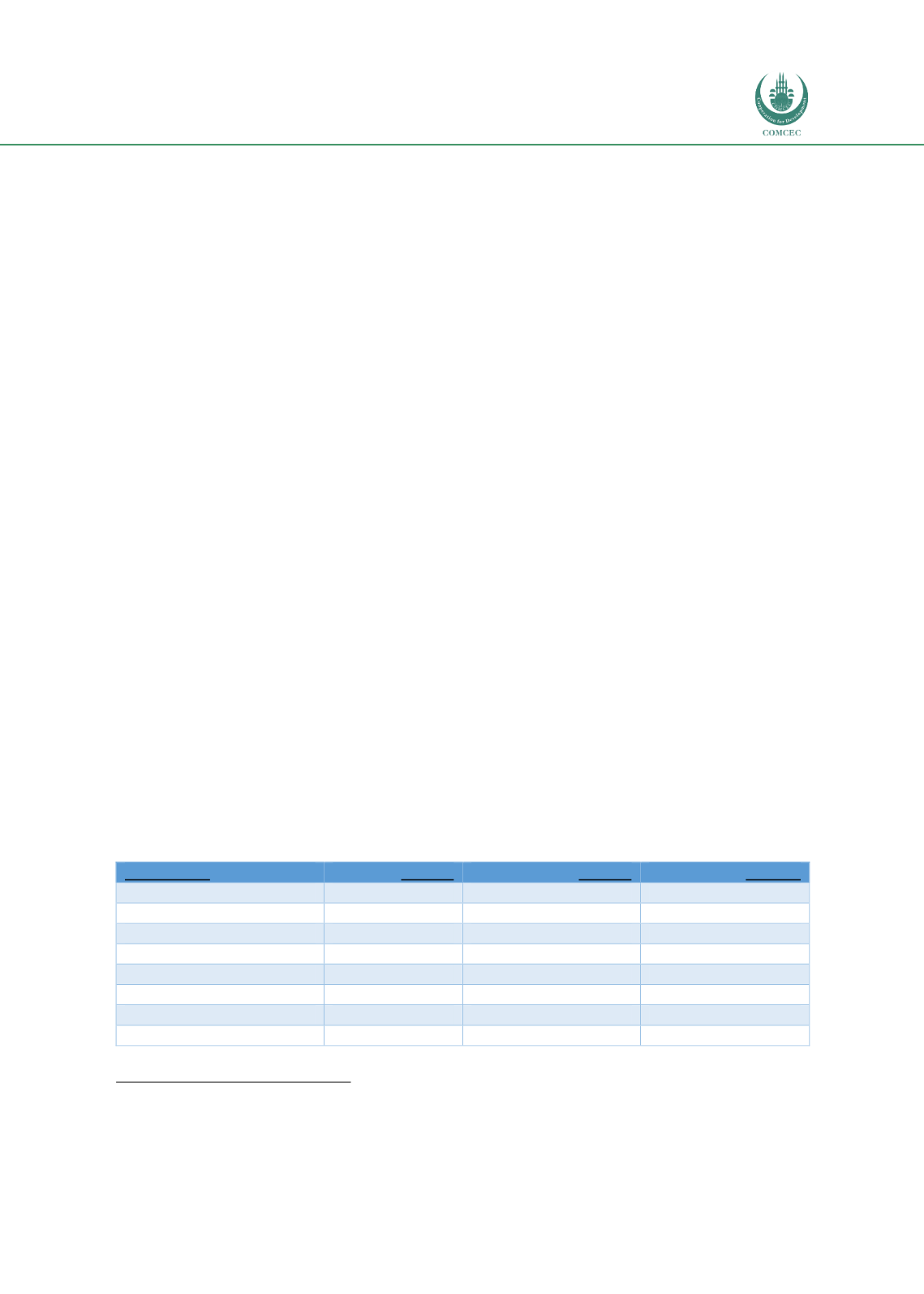
In terms of the popularity of Islamic financial instruments used by Islamic banks in Pakistan,
Diminishing Musharakah
is the most popular mode of financing, followed by
Murabahah
and
Musharakah.
In the calendar year 2016, the size, in terms of financing assets, of debt
based Murabahah decreased and that of Musharakah increased.
Table 29. Percentage Share of Instruments Used for Financing by Islamic Banks in Pakistan
Instrument
Dec-16
Dec-15
Change
Diminishing Musharakah
34.7
31.7
+3.0
Murabahah
15.8
24.5
-8.7
Musharakah
15.6
14.0
+1.6
Ijarah
6.8
6.6
+0.2
Salam
4.4
5.5
-1.1
Istisna
8.6
8.4
+0.2
Others
14.3
9.3
+5.0
Total
100
100
Source: SBP Islamic Banking Bulletin, December 2016
49
‘State Bank of Pakistan Islamic Banking Bulletin’, December 2016
50
As of December 2016, SBP Islamic Banking Bulletin
51
Pakistan Islamic Finance Country Report 2016