


 20 / 231

Diversification of Islamic Financial Instruments
6
15% share of Islamic banking asserts (as a percentage of total domestic banking assets). It also
marks Pakistan and Bahrain as countries with over 10% share of Islamic banking assets.
In this Study, chapter 1 provides an overview of the global Islamic financial industry landscape,
with Chapter 2 highlighting the Islamic banking, Islamic capital markets and Takaful segments
separately. Chapter 3 then presents individual case studies of the above mentioned ten
countries, examining the different products used in each of their Islamic banking, capital
markets and Takaful segments, and highlighting the major takeaways and recommendations.
Chapter 4 culminates with some policy recommendations for improving the Islamic financial
industry product diversification in OIC member countries, non-OIC member countries and the
major international Islamic financial institutions.
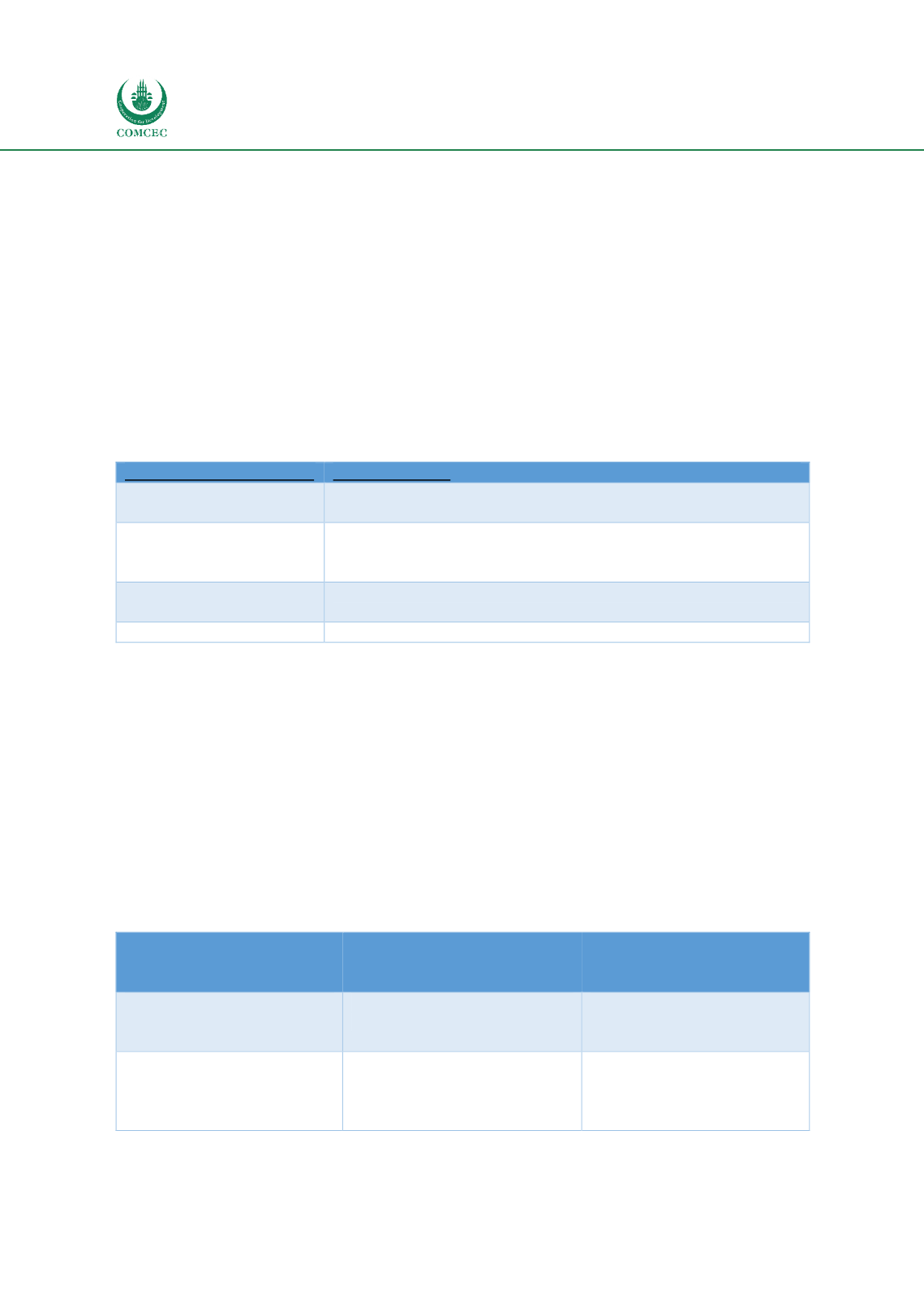
There are many different standard setters for these three main sectors of Islamic finance at the
global level. Some of them are given below;
Table 2 Sectors of Islamic Finance at the Global level
Global Financial Industry Standard Setter
Overall
Growth of Islamic Finance Assets (annual) as compared to
conventional sector
Islamic banking
Share of Islamic Banking segment of an OIC member country as a
percentage of the overall banking industry, measured in terms of
a) Deposits and b) Assets
Islamic capital markets
Total Size of issued international and sovereign Sukuk issued
(rated and non-rated).
Takaful
Size of total Takaful institutions’ assets.
Source: Created by Author
Diversification of Islamic financial instruments
refers to the different products (and their
underlying contracts) that are available in a given economy, in the Islamic banking, Islamic
capital markets and Takaful industries. For example, Islamic capital markets sector may
include Shariah compliant funds, short term, medium term and long term Sukuk structures
(based on Musharakah, or Ijarah etc.), Wakala-based asset management products etc. on The
significance of this diversification can be understood in that a sector offering a multitude of
diversified products, for example in Islamic banking, could mean that the sector is well
developed, is competitive, and caters to the different needs of the savers, investors, SMEs,
corporates, low income groups, regulators, bankers etc.
A general and brief glimpse of legal and regulatory environment that looks after the Islamic
finance industry is:
Table 3. Legal and Regulatory Environment of Islamic Finance Industry
Islamic banking institutions
Islamic capital markets segment
Takaful institutions and
Insurance companies with
Window Takaful operations
Regulated by the Central Bank
Regulated by the Securities and
Exchange commission
Regulated by the Securities and
Exchange commission. In few
countries by Central bank.
A Shariah Board at the Central
Bank serves as the main national
body for Shariah governance of
Islamic banks
Many OIC member countries’
Securities
and
Exchange
Commissions have their own
Shariah Boards.
Source: Created by Author