


 151 / 247

130
XL Axiata’s Ijarah Sukuk
Programme
(the largest corporate
ijarah
sukuk programme)
Subordinated
Mudarabah Sukuk
Bank BRI Syariah
Garuda Indonesia
Global Sukuk Limited
Wakalah Programme
Securities Trading
Limited (
SGX-ST
)
Geographical
distribution of
investors
More than 95% of the sukuk
had been offered to investors
domiciled in Indonesia,
comprising banks, pension
funds, insurance companies,
institutional investors,
securities houses and retail
investors
Indonesia (100%).
By investor type:
Insurance and pension
funds: 65%
Asset managers: 17%
Individuals: 15%
Banks: 3%
Middle East (56%),
followed by Asia
(32%), Europe (12%)
Sources: Islamic Finance News, Thomson Reuters,
sukuk.comIndonesia offers tremendous potential in building a healthy pipeline of corporates that issue
project-financed sukuk. Based on the government’s current budget requirements, a large
chunk of funding (via project-based sukuk) is already focused on infrastructure development.
In view of privatization benefits via public-private partnership schemes, the government and
the regulators are identifying potential SOEs and creditworthy corporates that can take the
lead in financing government infrastructure projects through sukuk issuance. The
government’s ambitious infrastructure plans are considered the biggest enabler in creating a
pathway for Indonesia’s Islamic finance since sukuk issuance serves as a natural hedge in
financing development projects (via project-based sukuk). Box 4.10 highlights the National
Medium-Term Development Plan (2015– 2019) for infrastructure development.
Box 4.10: Indonesia’s National Medium-Term Development Plan (2015-5019)
Under the National Medium-Term Development Plan
(2015– 2019), the infrastructure spending plan by
the Indonesian central government summed up to
IDR2,216 trillion (USD187.0 billion) over a 5-year
period or 2.9% of nominal GDP on an annual basis.
The government has set the overall investment target
at IDR5,519 trillion (USD465.7 billion) for the same
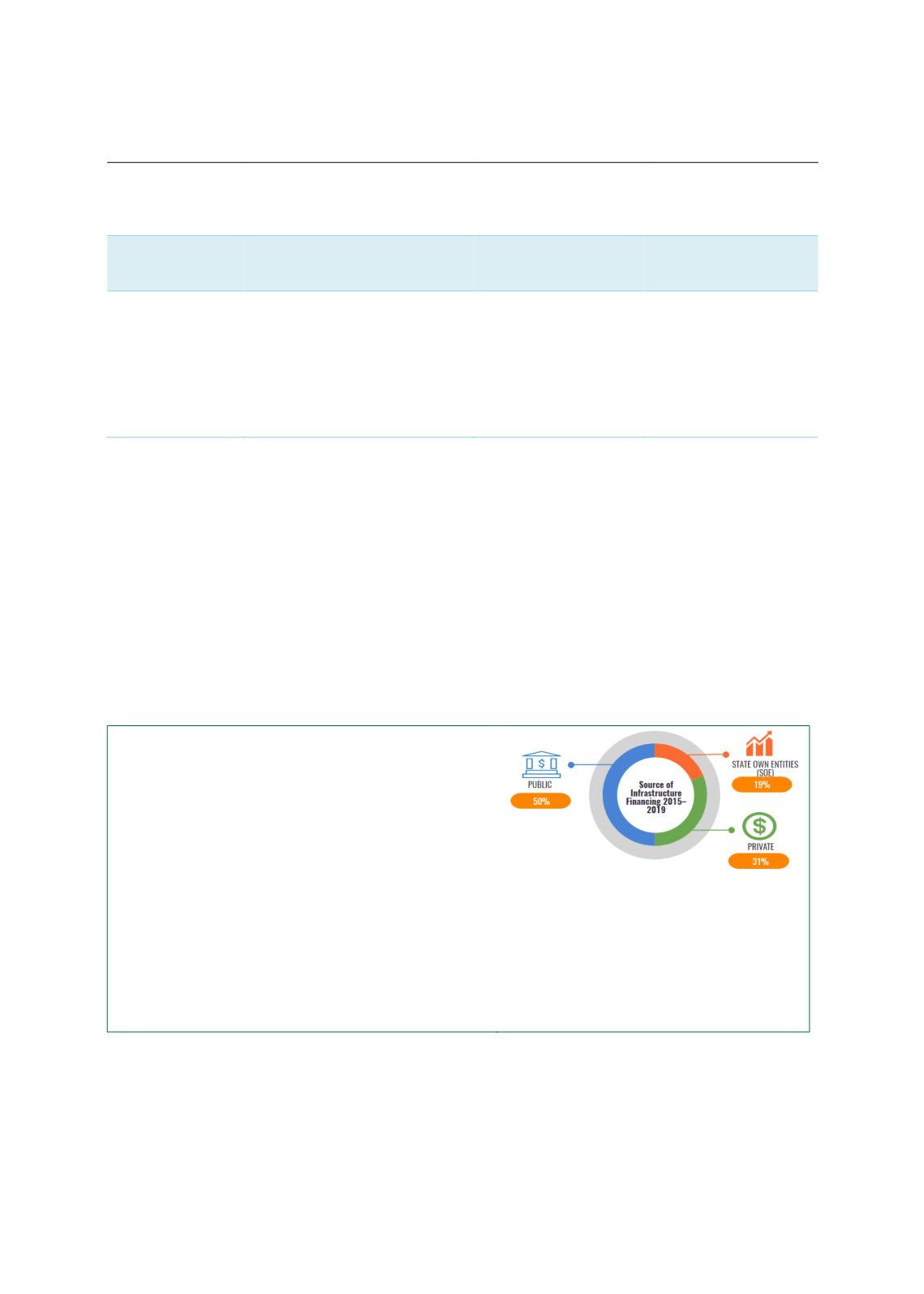
period, or 7.2% of annual GDP. State funding will
contribute 50% of the total investment, including
IDR545.0 trillion (USD46.0 billion) of sub-national
government funding, with 19% coming from SOEs
and 31% from the private sector.
The role of government, SOEs and private sectors in
developing infrastructure financing is summarized in
the following table: