



 55 / 127

Barriers and Opportunities for Enhancing Capital Flows
In the COMCEC Member Countries
47
opening are outlined in what has become known as the ‘institutional view’, which outlines the
importance of a number of factors to ensure that the risks associated with opening are
adequately mitigated.
The institutional view stresses the importance of identifying “thresholds” of financial and
institutional development that must be in place as a country liberalises. In this sense, there
should be “no presumption that full liberalisation is an appropriate goal for all countries at all
times” and that the correct sequencing of capital markets liberalisation is considered a priority
in policy design and implementation.
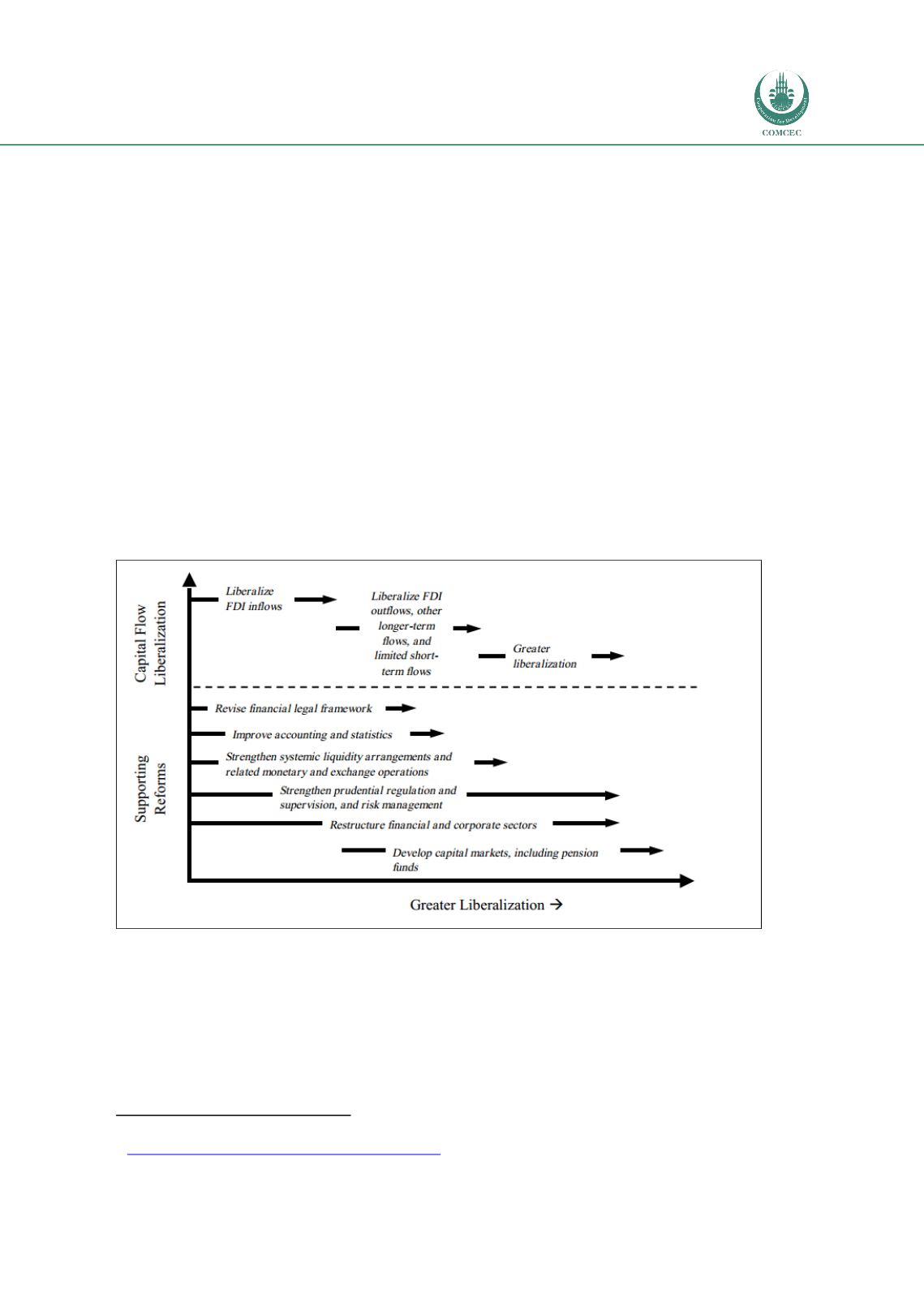
The result is a framework for phased capital flow liberalisation. The first phase of the
liberalisation process is FDI flows, which are considered stable and strongly correlated with
growth. As investments have longer time horizons and capital is “locked” in the receiving
country, FDI inflows provide a sound basis for long-term planning and decrease volatility. The
second phase of the liberalisation process is the liberalisation of FDI outflows and long-term
portfolio flows. As supporting reforms are implemented, greater liberalisation becomes safely
viable.
Figure 3.1: Stylised representation of a broad liberalisation plan
50
The sequencing of these phases should be based on country-specific circumstances and on
levels of institutional development. In particular, the institutional view includes assessments of
the following factors:
51
Macroeconomic and financial sector vulnerabilities
Institutional and market development
50
http://www.imf.org/external/np/pp/eng/2012/111412.pdf5
1 http://www.imf.org/external/np/pp/eng/2012/111412.pdf