



 54 / 96

Activation Policies for the Poor in OIC Member States
46
Legend
Male
Female
Maximus
Ingeus
Taqat Elm
Avanta
Al Quryat
Ar’ar
Sakaka
Dammam
Tabouk
Madinah
Jeddah
Makkah
Ha’il
Al Baha
Taif
Bureidah
Abha
Riyadh
Khobar
Al Hofuf
Najran
Jizan
Eastern Region
Najran
Ar Riyadh
Jizan
Aseer
Al Baha
Makkah
Qassim
Al Madinah
Tabouk
Hail
Al Jouf
Northern Border
Northern Border region is the least populous region of Saudi Arabia with only 350,000 residents
compared to Ar Riyadh that has a population in the region of 7.5 million. Over 90% of jobs posted on
the Taqat Online jobs portal were limited to three regions – Makkah, Ar Riyadh and the Eastern
Region. This may be indicative of opportunities within the three regions but is also likely to be
driven by the fact that employers in other regions are less likely to use this channel. Smaller scale
employers may be less likely to advertise online and in many cases jobs in more rural locations can
often be filled through word of mouth.
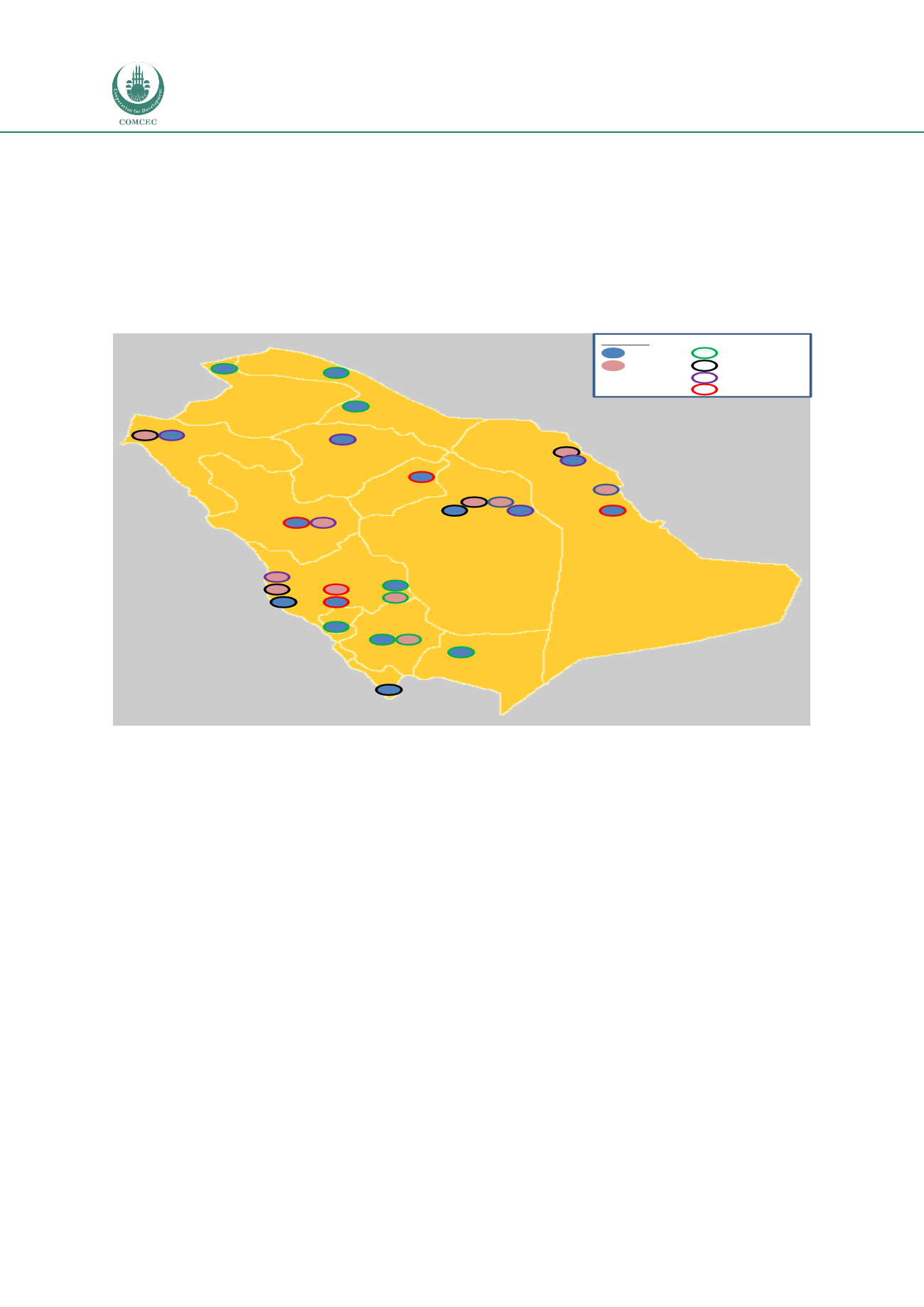
Figure 3: Map of JPCs in Saudi Arabia
Source: CESI representation based on provider data
Due to the inconsistent distribution of the Saudi population throughout the country, there are many
JPCs located in densely populated areas and very few in other regions. For example, as evident from
the map, there are no JPCs directly South and South East of Riyadh. This is why there is a reliance on
online services through the Taqat employment channels. The location of some JPCs also corresponds
to the planned locations of some of Saudi Arabia’s new economic cities such as in Jizan and Hail.
The government has sought to implement a payment model similar to the United Kingdom’s, based
on results. However, the lack of market maturity has meant providers have required fixed fees
initially to fund initial set up costs.
The government went through a period of setting up pilots, contracting providers to deliver services
rather than contracts being put out to tender. For this reason, payment models differ markedly
between providers and there is no standardisation. HRDF has been through a process of contract
renegotiation but the focus of the renegotiation was to reduce the payment of fixed costs and
increase the level of payment by results.
An important part of the payment model for existing providers has been ‘fixed’ payments to
providers to fund set up costs. As providers are becoming more embedded, the proportion of fixed
costs that the government is willing to pay is reducing significantly and more payments are being
made for attachments, placements and sustainment. The government has stated that it is focused on
paying providers according to measurable outcomes and results.
As with the maturity of the market, the proportion of payment that is based on results is far lower
than in the UK. Specific arrangements are commercially sensitive but are broadly based on a 50/50