


 61 / 181

Increasing Broadband Internet Penetration
In the OIC Member Countries
49
The fixed broadband demand gap estimates in table 14 require some interpretation. First, the
countries where the fixed broadband demand gap is lower than 10% indicates a
supply/demand equilibrium, where fixed broadband service coverage is matched by
household penetration. Not surprisingly, most of these countries are the developed ones
(Australia, Belgium, Canada, Denmark, France, Greece, Iceland, Ireland, Israel, Luxembourg,
Malta, Netherlands, New Zealand, Norway, Slovenia, Switzerland, United Kingdom)
25
. Second,
there are some advanced countries where the fixed broadband demand gap ranges between
10% and 20% (Estonia, Germany, Japan, Portugal, Spain, United States). In this case, the gap
can be explained primarily by fixed-mobile substitution. The early and aggressive deployment
of 4G mobile broadband technology has resulted in wireless capturing a portion of the fixed
demand. This also the case for some of advanced countries where the fixed broadband demand
gap exceeds 20% (Austria, Czech Republic, Finland, Italy, Sweden). Finally, there are some
emerging countries with a consistent imbalance between supply and demand, where the
demand gap reaches 30% and higher (Argentina, Bolivia, Chile, Colombia, Costa Rica, Ecuador,
Mexico, Romania). Reasons for this gap are multi-fold, ranging from limited affordability to
lack of local content. This point will be reiterated at the end of this section, after analyzing the
mobile broadband demand gap.
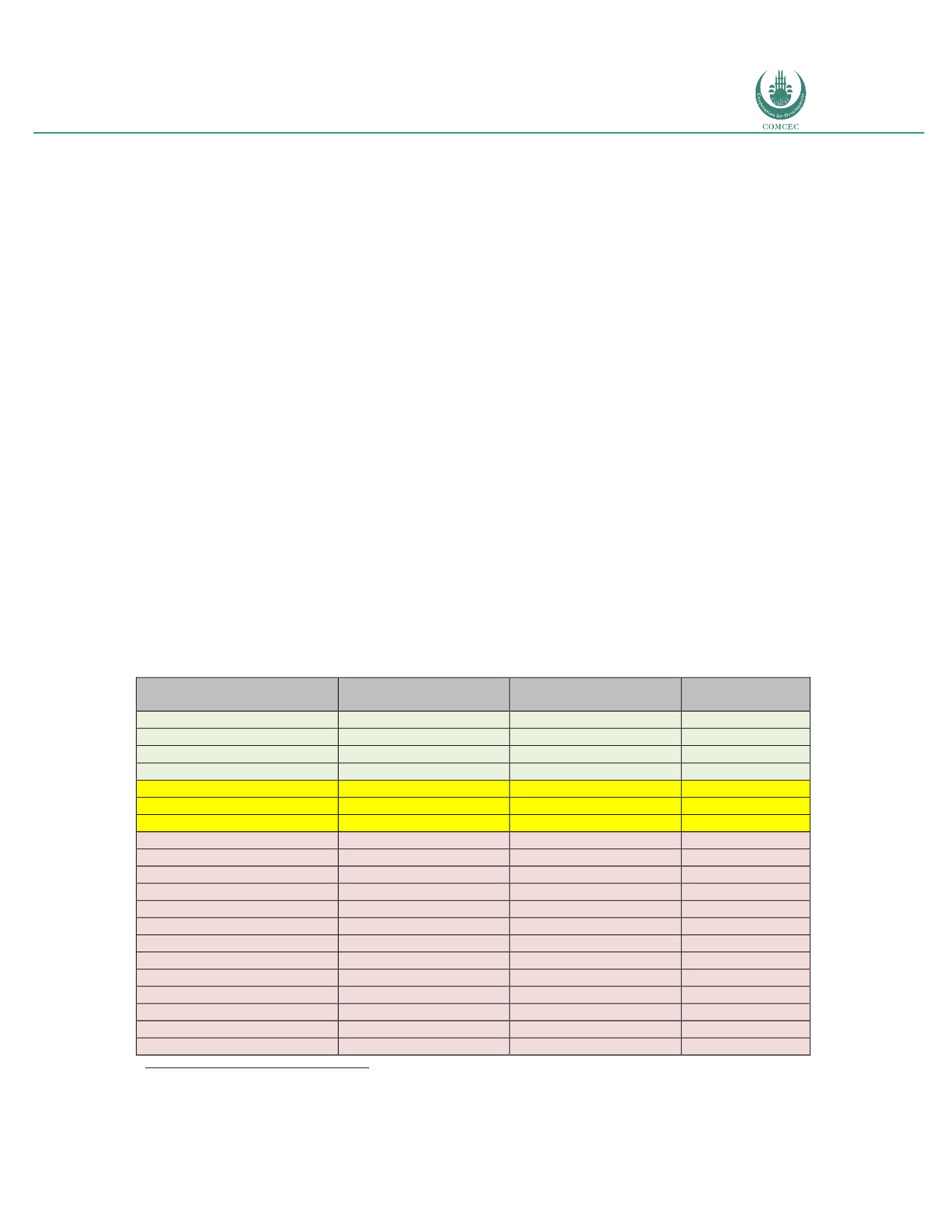
The mobile broadband demand gap is calculated by subtracting the percent of population that
are broadband subscribers from the percent of the population covered by 3G networks. In this
case, the estimates are calculated by region of the world because data is available for most
countries (see table 15).
Table 15: Mobile broadband demand gap (2015)
Country
Population Covered
(3G) (
%
)
Connections
Penetration (
%
)
Demand Gap (
%
)
Australasia
98.80
113.04 (*)
0
Northern America
99.80
103.93 (*)
0
Eastern Asia
61.95
62.96 (*)
0
Northern Europe
99.06
95.69
3.37
OECD Countries
97.78
87.17
10.61
Micronesia
15.34
0.27
15.07
Eastern Europe
76.92
58.54
18.38
Central Asia
54.86
33.20
21.66
Western Europe
97.64
74.75
22.89
Middle Africa
32.06
8.92
23.14
Southern America
91.28
67.37
23.91
Southern Europe
97.67
72.80
24.87
South-Eastern Asia
72.64
46.87
25.77
Northern Africa
72.56
43.13
29.43
Polynesia
48.56
18.41
30.15
Caribbean
54.02
19.78
34.24
Melanesia
46.57
11.15
35.42
Southern Africa
94.75
58.19
36.56
Western Asia
85.55
46.39
39.16
Western Africa
64.68
23.22
41.46
25
Uruguay is a particular emerging market case. A strong public program has recently completed an FTTH deployment, as a
result of which fixed broadband is being offered on a subsidized basis (e.g. low speed service is being connected for free).